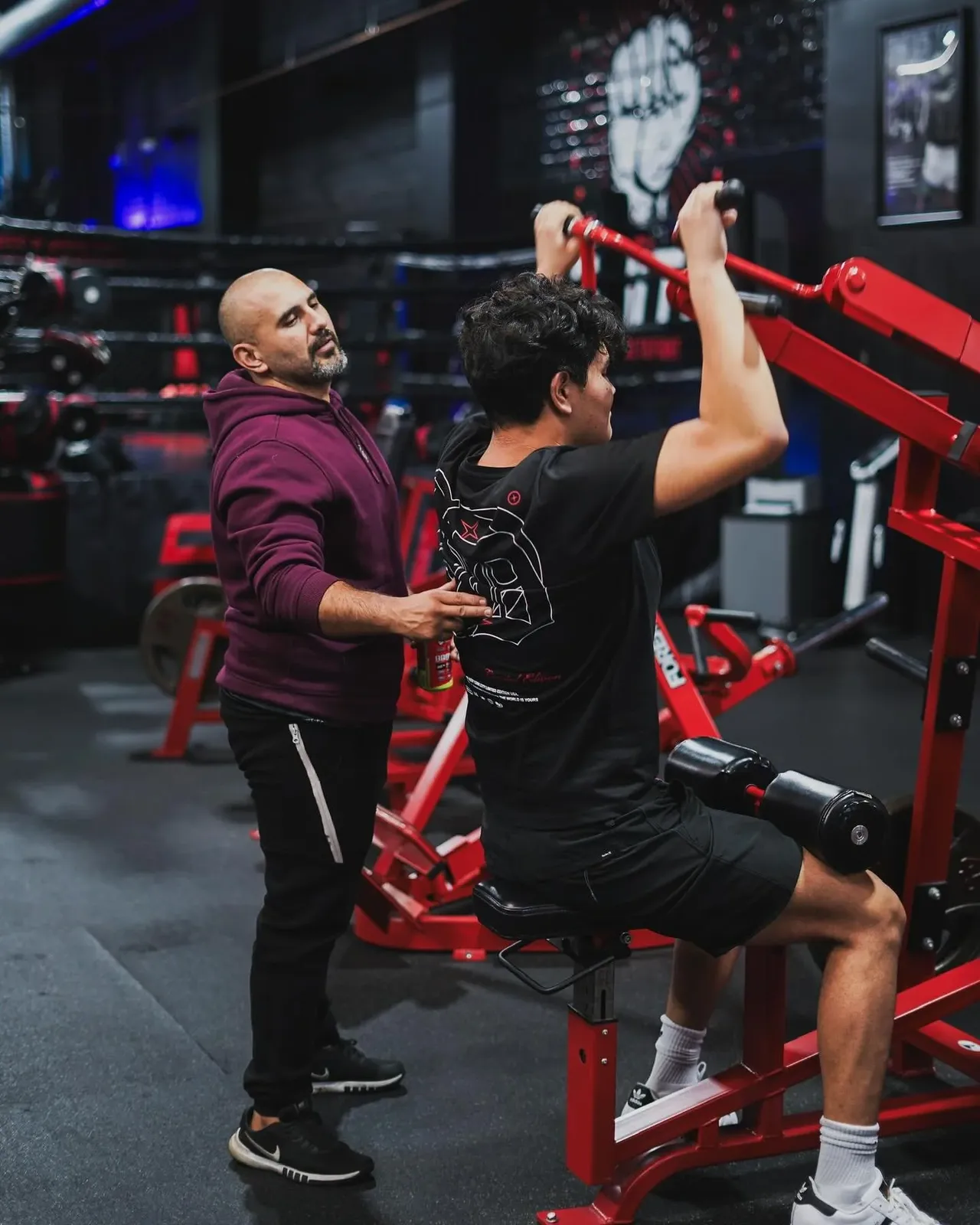
4 Proven Ways to Improve Your Power-to-Strength Ratio for Long Beach Athletes
Boost your power-to-strength ratio with 4 field-tested methods used by Trinity Training Facility in Long Beach. Test, train, and track real results.
Improving your power-to-strength ratio means training your nervous system to express existing strength faster, not just adding more weight to the bar. The four proven methods are: build a strength floor of 1.5x bodyweight before heavy plyometrics, use contrast training to pair heavy lifts with jumps, progress plyometric volume and box height deliberately, and space power sessions 48-72 hours apart for full CNS recovery. Long Beach athletes who skip these steps plateau even as their max lifts keep climbing.
A high school outfielder walked into Trinity Training Facility last spring squatting 275 pounds at 165 bodyweight — a 1.67x bodyweight ratio that would make most strength coaches nod in approval. His problem wasn't strength. His problem was that he still popped up to first base in 4.4 seconds and his outfield throws died 15 feet short of the cutoff man. He was strong. He wasn't powerful. That gap between what you can lift and what you can actually express on the field, in the ring, or off the line is what we mean by power-to-strength ratio, and it's the single most overlooked variable in athletic training programs around Long Beach.
Most gyms measure progress in one dimension: how much weight moved. Chain gyms and even a lot of local personal trainers track 1-rep maxes and call it a training program. But strength without speed of expression doesn't win a 60-yard dash, doesn't land a first punch, and doesn't help a volleyball player get above the net a half-second faster than her blocker. If you train at a facility that only chases bigger numbers on the bar, you are building a car with a huge engine and no transmission.
What Power-to-Strength Ratio Actually Measures
Power-to-strength ratio is a way of expressing how efficiently an athlete converts maximal force capacity into fast, usable force. In practical terms, we compare a strength marker (like a back squat 1RM) against a power marker (like a countermovement vertical jump or a standing broad jump) and look at the relationship between the two.
A useful field version of this is the Dynamic Strength Index (DSI): divide your best countermovement jump force output by your predicted force output from a 1RM squat. A DSI under roughly 0.6 usually signals a strength deficit — you need more raw force before power work pays off. A DSI above 0.8 usually signals the opposite: you're already strong relative to how fast you can apply that strength, and pure strength work will produce diminishing returns.
The outfielder from the intro tested at a DSI of 0.58. He didn't need a bigger squat. He needed to learn how to apply the squat strength he already had, fast, under 200 milliseconds instead of 2 seconds. That reframing is what separates results-driven programming from generic gym membership advice.
How We Test It Before Writing a Single Program
Before we program anything, we run a two-part baseline: a 3-attempt back squat 1RM (or a validated estimate from a rep-max set for newer athletes) and a countermovement vertical jump or broad jump, tested cold with full recovery between attempts. We're not guessing — we're building the number that tells us whether week one should look like a strength block or a power block.
For a 170-pound athlete, we want to see a broad jump in the range of 8 to 9 feet and a vertical jump of 24-28 inches before we consider the power side "developed" relative to strength. An athlete squatting 1.8x bodyweight but jumping 19 inches has a strength surplus sitting unused. An athlete jumping 30 inches off a 1.1x bodyweight squat is living on raw athleticism with no floor underneath it — usually the first to get hurt when contact sports intensify.
We retest both numbers every 4 weeks. That single habit — testing, not guessing — is the difference between athletes who plateau for a full season and athletes who show measurable jumps (literally) every training block.
Way 1: Build the Strength Floor Before You Chase Speed
You cannot express force you don't have. This is the part every plyometric-obsessed Instagram account skips. If an athlete's back squat sits under 1.3x bodyweight, we spend 4-6 weeks almost exclusively on strength: 3-5 sets of 3-5 reps at 80-90% of 1RM on squat, trap bar deadlift, and split squat variations, twice a week.
This isn't about grinding out ugly max singles. It's about building a nervous system and tendon structure that can tolerate the eccentric loading that real power training demands later. Skipping this step is the number one reason we see new clients come to us from other programs with cranky knees and patellar tendon irritation — they were doing depth jumps off 24-inch boxes with a squat that couldn't handle their bodyweight for five clean reps.
A simple rule we use with high schoolers and adult recreational athletes alike: get to 1.5x bodyweight in the back squat (1.75-2x for football linemen and boxers who need to move mass, not just their own body) before layering in meaningful plyometric volume. Below that threshold, plyometrics become a party trick with declining returns and increasing injury risk. Above it, they become one of the highest-leverage tools we have.
The NSCA's guidance on periodized resistance training supports this sequencing — strength qualities need to be established before rate-of-force-development work can reliably build on top of them.
Way 2: Use Contrast Training to Bridge Strength and Speed
Once the strength floor is in place, contrast training is the fastest way we've found to convert a 1RM into usable power. The method is simple: pair a heavy compound lift at 85-90% of 1RM for 2-3 reps with an explosive movement of the same pattern — heavy back squat into broad jump, heavy trap bar deadlift into box jump, heavy bench press into a plyo push-up or medicine ball chest pass.
The physiology behind it is post-activation potentiation: the heavy lift recruits high-threshold motor units that stay primed for roughly 4-12 minutes, and the explosive movement immediately after rides that neural activation to produce more power than it could generate cold. Research compiled on PubMed around complex training and post-activation potentiation backs this up consistently across trained populations.
Our standard contrast block: 3 heavy squats at 87% 1RM, rest 15-20 seconds, then 5 broad jumps for max distance, rest 2-3 minutes, repeat for 4 total rounds. We log broad jump distance every round — most athletes hit their longest jump on round 2 or 3, not round 1, which is exactly the potentiation effect we're chasing. If distances drop off by round 4, that's the session's natural stopping point; grinding through fatigued reps here builds nothing but bad landing mechanics.
Way 3: Progress Plyometrics by Contact Time, Not Just Reps
Plyometric training done well is one of the most efficient tools for closing the power-to-strength gap. Plyometric training done carelessly is how athletes end up with shin splints and patellar tendinopathy by October. The difference is progression logic.
We start every athlete — regardless of sport — on low-amplitude work: ankle hops, pogo jumps, and box step-offs from a 12-18 inch box focused on quiet, fast landings. Only after 2-3 weeks of clean mechanics do we introduce depth jumps from a 20-24 inch box, where the goal is a ground contact time under 200 milliseconds. If an athlete "sticks" the landing and pauses before jumping again, that's not a depth jump anymore — it's just a jump off a box, and it's not training the reactive quality we're after.
Volume matters as much as intensity. Early-phase athletes should stay in the range of 60-80 total foot contacts per session; advanced, well-conditioned athletes can handle 100-120. We increase box height or contact demand roughly every 2 weeks, never both variables at once. A boxer training for explosive hip rotation and a soccer player training for change-of-direction speed will use different jump directions and planes, but the contact-time principle stays identical across sports.
Way 4: Protect the Nervous System Between Sessions
Power training taxes the central nervous system far more than most athletes and even some trainers realize. A hard contrast or plyometric session can take 48-72 hours to fully recover from, even when the muscles themselves don't feel particularly sore. This is the piece that trips up motivated athletes who want to train power every single day — they end up training fatigue, not power.
We watch for three warning signs that an athlete needs more recovery before the next power session: grip strength dropping more than 10% from baseline (a simple dynamometer or even a hand-grip check tells you this), jump height dropping 2+ inches from the prior session's warm-up numbers, and resting heart rate elevated more than 5-7 beats above normal on waking. Any one of those and we swap the planned power session for mobility work or light technical drills instead.
Sleep is non-negotiable here — 7-9 hours, consistently, not just the night before a big session. Athletes juggling school, work, and travel around Long Beach (plenty of our clients commute from Signal Hill, Lakewood, and Los Alamitos) often treat sleep as the flexible variable in their week. It's actually the least flexible one if power output is the goal. We schedule power sessions on a hard 48-72 hour spacing — typically Monday and Thursday, or Tuesday and Friday — and never stack two power days back to back regardless of how good an athlete feels.
Common Mistakes Long Beach Athletes Make Chasing Power
The most common mistake is sequencing: athletes jump straight into depth jumps and Olympic lift variations without the strength base to support them. We see this constantly with athletes coming from group classes that program the same plyometric circuit for a beginner and a college athlete alike. The fix is simple but requires patience — spend the 4-6 weeks building the strength floor even if it feels less exciting than jump training.
The second mistake is training power in a fatigued state, usually because it's tacked onto the end of a long conditioning session. Power work needs to happen when the nervous system is fresh, ideally at the start of a session after a thorough warm-up, not as an afterthought following 40 minutes of conditioning circuits.
Third, athletes chase 1RM strength numbers weekly instead of retesting on a sensible cycle. Constant max-effort testing accumulates joint stress without giving the adaptation window time to show up in performance. We test strength and power markers every 4 weeks — enough time for a real training effect, not so long that programming drifts without feedback.
Finally, landing mechanics get ignored in favor of jump height. An athlete who jumps 30 inches but lands with knees caving inward is building a future ACL problem, not power. Every plyometric progression at Trinity starts with a coach watching the landing before we ever add height or load.
A Sample 4-Week Power-to-Strength Block
For an athlete who has already established a 1.5x bodyweight squat, here's a simplified version of a block we'd run:
This isn't a one-size-fits-all template — a boxer's block looks different from a baseball pitcher's, with more rotational medicine ball work and less bilateral jumping. But the strength-then-contrast-then-plyometric-then-deload skeleton holds across almost every sport we train for.
Tracking Progress Without a Sports Science Lab
You don't need force plates or a $3,000 jump mat to know if your power-to-strength ratio is improving. A tape measure, a wall, some chalk, and a stopwatch cover 90% of what matters. Standing broad jump, measured heel-to-line at takeoff to heel-at-landing, is one of the most reliable field tests we use — it correlates well with lower-body power output and takes 5 minutes to administer.
Vertical jump against a chalked wall (reach height marked, jump-and-touch height marked, subtract the difference) works just as well and is easier for athletes to self-administer between sessions. A 10-yard sprint time, hand-timed consistently by the same person with the same start method, rounds out a simple but genuinely useful field-testing kit.
What matters most is consistency of testing conditions — same warm-up, same time of day when possible, same recovery state. An athlete who jumps 26 inches fatigued on a Friday afternoon and 24 inches fresh on a Tuesday morning hasn't necessarily lost power; the conditions changed. Log the numbers every 4 weeks, note the context, and look at the trend line, not any single data point.
When It's Time to Bring In a Coach
Athletes can absolutely make progress on power development on their own, especially once they understand the strength-first sequencing outlined here. But the technical coaching around landing mechanics, contrast timing, and load progression is where most self-guided programs break down — usually right around the point where motivation is highest and patience for "boring" strength work is lowest.
At Trinity Training Facility, every new athlete starts with the same baseline assessment described above: a strength test, a power test, and a DSI calculation that tells us exactly which of the four methods to prioritize first. From there, programming is built around your actual numbers, not a generic template pulled from a gym class or an app.
Key Takeaways
- Power-to-strength ratio measures how much of your maximal strength you can actually express quickly — a strong squat means nothing on the field if it doesn't transfer to speed.
- Athletes need roughly 1.5x bodyweight in the back squat before heavy plyometric work produces meaningful power gains rather than just joint stress.
- Contrast training (heavy squat immediately followed by a jump variation) uses post-activation potentiation to recruit more fast-twitch fibers in the same session.
- Plyometric progression should be measured in ground contact time and box height, not just rep count — sloppy landings build bad habits faster than they build power.
- CNS fatigue from power work takes 48-72 hours to clear, so back-to-back heavy jump sessions usually cause athletes to regress, not improve.
- Field tests like broad jump distance and vertical jump height, retested every 4 weeks, tell you more about real progress than another 1RM attempt.