5 Key Exercises to Improve Functional Strength for Everyday Activities in Your 40s and Beyond
Build functional strength in your 40s with these 5 exercises. Long Beach trainers share sets, reps, and progressions that carry over to real life.
The five most effective exercises for functional strength after 40 are the goblet squat, split squat, loaded carry, hinge pattern (trap bar deadlift), and a push-pull pairing (row and press). Together they train the movement patterns — squatting, lunging, carrying, hinging, pushing, pulling — that everyday life demands, and they directly counter the age-related muscle loss that starts accelerating in your 40s and 50s.
Mark walked into our Long Beach facility at 47 years old after throwing his back out picking up a suitcase. Not a heavy suitcase — a normal, 30-pound roller bag he'd lifted a thousand times before. He wasn't injured from an accident or a sport. He was injured because his body had quietly lost the strength and movement pattern needed to hinge at the hips and lift something off the ground, and nobody told him until it failed on him in an airport terminal.
That story isn't rare. It's the single most common reason people in their 40s and 50s walk through our doors: not a desire to look a certain way, but a wake-up call that everyday movement — lifting a kid, carrying moving boxes, getting off the floor — suddenly feels harder or riskier than it used to. Functional strength in your 40s isn't about chasing a bigger bench press. It's about making sure your body can still do the things you need it to do, reliably, for decades. Below are the five exercises we build almost every client's program around, along with the exact sets, reps, and progressions we use.
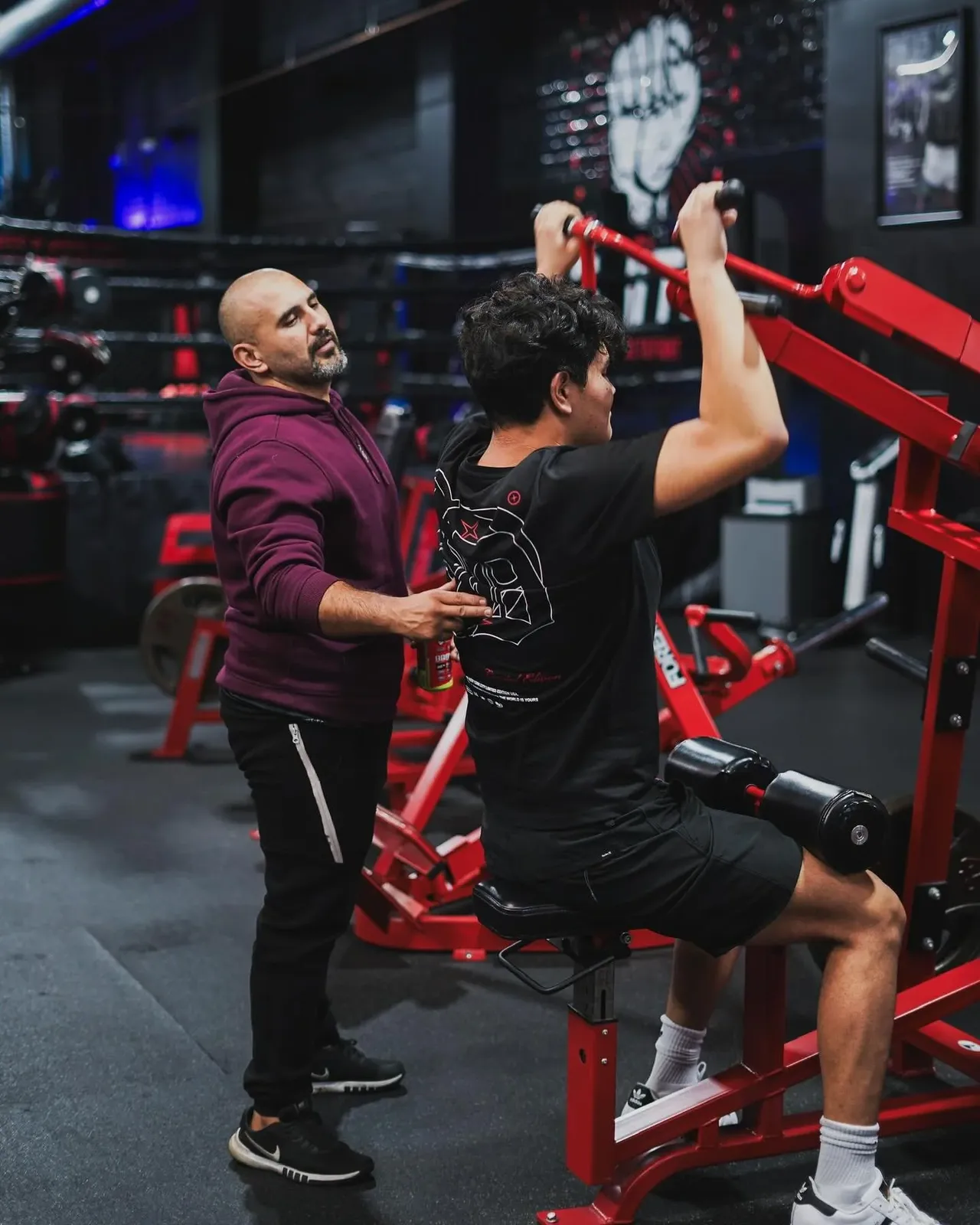
Why Functional Strength Matters More After 40
Muscle mass doesn't decline evenly across your life. Research summarized by the National Institute on Aging shows adults lose roughly 3 to 8 percent of muscle mass per decade starting around age 30, and that rate accelerates significantly after 60. Strength — which matters more than size for daily function — tends to decline even faster than muscle mass, particularly in the type II "fast twitch" fibers responsible for quick, powerful movements like catching your balance on uneven pavement.
This isn't inevitable decline you have to accept. The ACSM's position on resistance training makes clear that adults of any age respond to progressive overload with measurable strength and muscle gains, often at rates comparable to trainees in their 20s. What changes with age is the margin for error — recovery takes longer, joints tolerate less randomness, and old injuries need to be programmed around rather than ignored.
Functional strength training addresses this directly by prioritizing movement patterns over isolated muscles. A person who can squat, hinge, lunge, carry, push, and pull with good load and control is a person who can get off the floor, climb stairs with groceries, and catch themselves if they trip. That's a different goal than isolated bicep curls, and it's why our programming for clients over 40 centers on compound, multi-joint lifts first.
Exercise 1: Goblet Squat
The goblet squat is the first exercise we teach almost every new client over 40, because it rebuilds the squat pattern — the same movement used to sit down, stand up, and get off a low couch — without the technical demands or spinal loading of a barbell back squat.
Hold a dumbbell or kettlebell vertically at chest height, feet shoulder-width apart. Sit back and down, keeping the weight centered over your midfoot, and go as deep as your hips and ankles allow while keeping your torso upright. The load held in front counterbalances you, which makes it easier to maintain good depth and posture compared to a barbell version.
We typically start clients at 3 sets of 10-12 reps with a 20-35 pound dumbbell, adding 5 pounds every one to two weeks as form holds steady. Once a client can comfortably manage 50 pounds for 12 clean reps, we transition toward front-loaded or trap bar squat variations for continued progress. For a deeper breakdown of how we sequence load increases like this over a full training block, see our guide on progressive overload for strength training.
Common mistake: letting the knees cave inward or the heels lift as depth increases. If either happens, that's the depth ceiling for now — chasing further range before hip and ankle mobility catch up is how people over 40 aggravate knees they didn't need to aggravate.
Exercise 2: Rear-Foot Elevated Split Squat
Nearly every fall, stumble, or "tweaked something" moment in daily life happens on one leg — stepping off a curb, catching yourself on stairs, pivoting to grab something. Yet most people's training is entirely bilateral, meaning they never build the single-leg strength and balance that actually matches how their body gets challenged in real life.
The rear-foot elevated split squat (Bulgarian split squat) is our go-to fix. Stand a few feet in front of a bench with one foot resting on it behind you, laces down. Lower your front knee toward the ground under control, keeping most of your weight through the front leg, then drive back up.
We start clients at bodyweight or light dumbbells, 3 sets of 8 reps per leg, focusing entirely on control and balance before adding load. Once that's solid, we add dumbbells in each hand, progressing in 5-pound increments per side. A client who started at bodyweight in January is often carrying 25-pound dumbbells per hand by April — a meaningful jump in single-leg strength that translates directly to stairs, hiking, and stability on uneven ground.
Common mistake: rushing the eccentric (lowering) portion. A controlled 2-3 second descent builds far more usable strength and stability than a fast drop, and it's safer for the front knee. This is the same principle we cover in our article on building functional strength through progressive overload.
Exercise 3: Loaded Carry
If we had to pick one exercise that best represents "real life" in the gym, it's the loaded carry. Grocery bags, a toddler on one hip, a suitcase through an airport, a cooler down to the beach — all of it is a loaded carry, and almost nobody trains it directly.
The farmer's carry is the simplest version: pick up a heavy dumbbell or kettlebell in each hand and walk, keeping your shoulders back, ribs stacked over your hips, and core braced. We program this for distance or time rather than reps — typically 3-4 rounds of 40-50 yards, or 30-45 seconds of continuous walking.
Load progression here is aggressive compared to other lifts because the demand is largely grip and postural endurance, not maximal strength. A client might start carrying 25-pound dumbbells for 40 yards and be up to 45-50 pounds per hand within 8-10 weeks. Grip strength specifically is worth tracking — it's one of the most studied predictors of overall health and longevity in adults over 50, showing up repeatedly in population research as a marker doctors use alongside blood pressure and cholesterol.
Variations we rotate in include the single-arm suitcase carry (one dumbbell, one side, forcing the core to resist lateral bending) and the rack carry (weight held at shoulder height, front-loaded). Common mistake: letting the shoulders round forward or the weight pull you into a lean. If your posture breaks down before the set time is up, the load is too heavy — drop it 10-15 pounds and rebuild.
Exercise 4: Trap Bar Deadlift
The hip hinge is the pattern behind Mark's suitcase injury, and it's the single most important pattern to rebuild in your 40s because it governs how you bend down to pick up literally anything — a laundry basket, a bag of dog food, a grandchild.
We use the trap bar almost exclusively for clients over 40 instead of a straight barbell deadlift, because the neutral grip and centered load reduce shear stress on the lower back while still training the same hip-dominant pattern. Stand inside the trap bar, hinge at the hips with a flat back, grip the handles, and drive through the heels to stand, squeezing the glutes at the top.
We start most clients with just the bar or a light load, focusing entirely on the hinge pattern — hips back, spine neutral, weight through the heels — for 3 sets of 8 before adding meaningful plates. From there, progression is typically 10-pound jumps every one to two weeks. Clients training consistently often move from a 65-pound trap bar deadlift to 135-185 pounds over a 12-week block, which we map out in detail in our periodized strength training plan.
Common mistake: rounding the lower back to chase more weight. The trap bar makes the lift more forgiving, but it doesn't make bad form safe — we cap load increases the moment we see the spine lose its neutral position, no exceptions.
Exercise 5: Push-Pull Pairing (Row and Press)
Upper body function in daily life is almost always a mix of pushing and pulling — pushing a door open, pushing yourself up off the floor, pulling a heavy bag off a shelf, pulling a stuck drawer. Training push and pull together keeps the shoulders balanced, which matters more after 40 because shoulder impingement and rotator cuff issues become more common as posture and tissue quality shift with age.
We pair a horizontal row (single-arm dumbbell row or cable row, 3 sets of 10-12) with a horizontal or overhead press (dumbbell bench press or standing dumbbell press, 3 sets of 8-10). Training them back-to-back in the same session, roughly matched in volume, prevents the common pattern we see in people who've only ever "benched" — overdeveloped chest and front shoulders, underdeveloped upper back, and a forward-rounded posture that makes everyday reaching and lifting harder, not easier.
Load progression for the row usually outpaces the press — clients often add 5 pounds to their row every 1-2 weeks while the press moves more like every 2-3 weeks, since pressing strength typically develops slower for clients newer to structured training. For a broader look at how we sequence upper body work across a full month, our 4-week upper body strength plan breaks down a full progression.
Common mistake: skipping the row because pressing feels more satisfying. If you only have time for one, do the row — most desk-bound adults need the postural correction more than they need another push variation.
How to Program These Five Exercises Together
Individually, these five exercises are useful. Programmed together across the week, they cover every major movement pattern your body needs for daily function. Our standard template for a client in their 40s training three days a week looks like this:
This isn't random exercise selection — it's a rotation that hits squat, hinge, lunge, carry, push, and pull patterns at least twice each per week, which is the frequency research generally supports for building and maintaining strength in adults over 40. We usually add 5-10 pounds to at least one lift every session for the first 8-12 weeks with a new client, then slow progression to every 1-2 weeks as loads get heavier and recovery becomes the limiting factor rather than motivation.
Rest between sets runs 60-90 seconds for accessory work and up to 2-3 minutes for the trap bar deadlift and heavier squat variations. Clients who rush rest periods to save time tend to see form break down by the third set — a shortcut that costs more than it saves.
Common Mistakes People Over 40 Make With Strength Training
The single biggest mistake is inconsistent load progression — either staying at the same weight for months out of caution, or jumping too much too fast because a set felt easy. Both stall results. The fix is simple and unglamorous: track your numbers every session and add load in small, boring increments once a lift feels genuinely controlled at the current weight.
The second mistake is skipping the warm-up. Adults over 40 generally need more tissue preparation than they did at 25 — 5-8 minutes of dynamic movement (leg swings, band pull-aparts, bodyweight squats) before loading up isn't optional, it's part of the session. We've had clients cut this corner and pay for it with a strained hip flexor that cost them three weeks of training.
Third, people over-index on cardio and under-index on strength, assuming walking or cycling alone will "keep them in shape." Cardiovascular work matters, but it doesn't build or preserve muscle mass, and muscle is what's declining fastest. The CDC's physical activity guidelines specifically call for muscle-strengthening activity at least two days a week, separate from aerobic exercise, for exactly this reason.
Finally, people train around pain instead of addressing it. A twinge in the knee during a squat isn't something to push through — it's information. We adjust range of motion, load, or exercise selection immediately rather than letting a client grind through discomfort that could become a real injury.
Building Your Foundation Starting This Week
You don't need six exercises, a complicated split, or two hours a day to rebuild functional strength in your 40s. You need these five patterns, trained consistently, with load that increases in small steps over months, not days. Start with two sessions this week — even 30 minutes each — focused on the goblet squat, split squat, and farmer's carry, and add the trap bar deadlift and row-press pairing once those feel controlled.
Key Takeaways
- Muscle mass declines roughly 3-8% per decade after age 30, accelerating after 60, making resistance training a non-negotiable part of aging well.
- Functional strength exercises train movement patterns — squat, hinge, lunge, carry, push, pull — rather than isolated muscles.
- The goblet squat, split squat, loaded carry, trap bar deadlift, and row/press pairing cover all six foundational patterns in one weekly program.
- Training these patterns 2-3 times a week with progressive load is more effective long-term than random workouts or cardio alone.
- Grip strength and single-leg stability are two of the strongest predictors of independence and fall risk after age 60.
- Form breakdown, not age, is usually what sidelines people in their 40s — proper loading and progression prevent that.