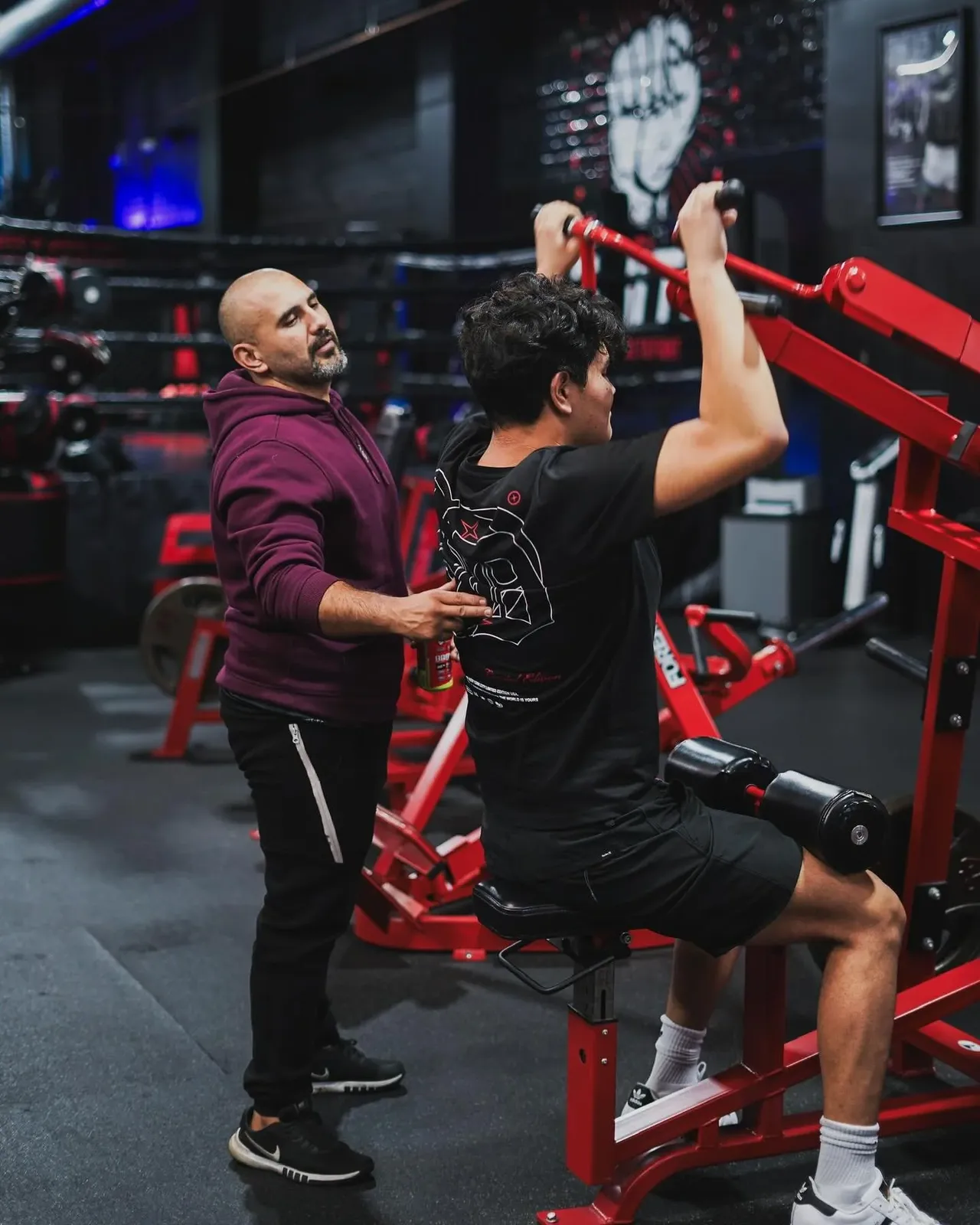
Mobility Training for Boxing Performance in Long Beach
Stiff hips and a locked-up thoracic spine kill punching power. Here's how Long Beach boxers use mobility work to hit harder and last longer.
Mobility training for boxing means restoring rotation in the hips, thoracic spine, ankles, and shoulders so power can transfer from the ground through the fist. Boxers with restricted hip and spinal rotation punch with 30-40% less power and fatigue faster because they compensate with the arms and shoulders. A 10-12 minute dynamic mobility warmup before every session, plus dedicated recovery-day work, fixes this in 4-6 weeks.
A guy walks into Trinity Training Facility wanting his hands back after four years away from boxing. He can still hit — 400-plus pounds on the bag tracker, decent footwork on flat ground, good hand speed. Three rounds into his first sparring session his output drops by half and his jab turns into an arm punch with no hip behind it. That's not a conditioning problem. That's a mobility problem, and it's the same one we see in most of the boxers who walk through our doors in Long Beach.
Punching power doesn't come from your shoulder. It comes from your hips, transfers through your thoracic spine, and gets delivered through a shoulder and wrist that can only do their job if everything upstream is moving correctly. If your hips don't rotate, your spine doesn't turn, or your ankles can't pivot, you're fighting with a fraction of the power you actually have available — and you'll gas out trying to make up the difference with your arms. Here's exactly which joints matter for boxing, how to test them yourself, and the mobility work we program for boxers training in Long Beach.
Why Hip Rotation Determines How Hard You Actually Hit
Every meaningful punch — jab excluded — starts with a hip turn. Your rear hip rotates internally while your lead hip rotates externally, and that rotation is what whips your torso and fist forward. If your rear hip can't internally rotate at least 40-45 degrees, you physically cannot complete that turn, so your body compensates by winding up with the shoulder instead. It looks like power on the bag because the bag doesn't fight back, but under fatigue in sparring or in a fight, that compensation pattern collapses first.
Test it yourself: sit on the floor in a 90/90 position, front shin and back shin both bent to 90 degrees, and try to sit up tall without your hands on the floor. Most people who spend 8+ hours a day driving or at a desk — a huge chunk of our Long Beach client base commuting from Signal Hill, Lakewood, and the 405 corridor — fail this test on at least one side. That tightness is the same tightness limiting their rear-hand power.
Fix it with 90/90 hip switches (8 reps per side), couch stretch (45 seconds per side, done daily, not just on training days), and cossack squats (6 per side, going as low as your hips allow without the heel lifting). We also see hip restriction show up as compensation patterns elsewhere in the kinetic chain — if you want the full breakdown of how these compensations wreck a lifting program, we cover it in Tailoring Your Strength Training: 3 Mistakes to Avoid.
Thoracic Spine Rotation Is Your Real Power Source
The hip generates the force. The thoracic spine transfers it. If your upper back is locked up — which is standard for anyone who sits, drives, or has spent years benching without balancing pulling and rotational work — the rotation your hips just created has nowhere to go. It dies somewhere around your ribcage instead of reaching your fist.
A boxer needs roughly 50-60 degrees of thoracic rotation per side to throw a full rear cross without over-relying on the shoulder joint. You can eyeball your own restriction with a simple test: sit on a bench, cross your arms over your chest, and rotate as far as you can each direction while keeping your hips still. Most boxers we test are asymmetrical — 10-15 degrees tighter on one side — which is exactly why one side of their combinations looks noticeably crisper than the other.
Open books (6 per side, controlled, not fast), quadruped thoracic rotations (8 per side), and landmine rotations with a light barbell (10 per side, 2 sets) are the three drills we program most. Landmine rotations in particular double as a strength exercise, which is why we usually pair mobility and strength work in the same session rather than treating them as separate categories — a concept we go deeper on in our 6-Week Strength Training Program for Boxers.
Ankle Mobility and the Footwork Most Boxers Skip
Nobody thinks about their ankles until they roll one in sparring. But ankle dorsiflexion — the ability of your shin to travel forward over your foot — is what lets your rear foot pivot when you throw a cross or hook. Without it, your foot stays flat and planted, your hip can't fully rotate, and you're back to punching with your arm. Worse, a flat, over-planted rear foot under load is one of the most common ways we see boxers roll an ankle mid-combination.
Test it with the knee-to-wall check: stand facing a wall, toes about 4-5 inches away, and try to touch your knee to the wall without your heel lifting. If you can't get there at 4 inches, your ankle mobility is limiting your pivot before your hip even gets involved.
Three drills fix this fast: banded ankle mobilizations (10 per side, holding a light band around the front of the ankle to create traction while you rock the knee forward), calf stretch off a step (30 seconds per side), and tibia glides against a wall (8 slow reps per side). We run these into every warmup before footwork drills. For the footwork and hand-speed side of the equation once mobility is sorted, our guide on Boxing Workouts for Faster Hands and Better Endurance breaks down the drills we layer on top.
Shoulder and Scapular Mobility for a Guard That Doesn't Drop
By round three, most boxers' guards drop — and it's usually blamed entirely on conditioning. Conditioning is part of it, but restricted shoulder flexion and poor scapular control make the guard more expensive to hold in the first place. If you can't comfortably get your arm overhead with full external rotation, holding your hands up at chin height for three-minute rounds burns far more energy than it should.
We test shoulder mobility with a simple wall slide: back flat against a wall, arms in a goalpost position, sliding overhead while keeping contact with the wall the whole way. Most boxers lose wall contact somewhere around ear level — that's the restriction showing up in real time.
Program band pull-aparts (15 reps, light band, focus on squeezing the shoulder blades), wall slides (8 slow reps), and thoracic extension over a foam roller (10 reps, done for 60 seconds total) three to four times a week. This is also where muscle imbalances from years of pressing without matching pulling volume show up hardest — we've written a full breakdown of the specific imbalances that sabotage boxers and lifters alike in 8 Muscle Imbalances Sabotaging Your Strength Training.
The 12-Minute Mobility Warmup We Run Before Bag Work
Here's the actual warmup we run with boxing clients before bag work or sparring, start to finish, no guesswork:
Total time: about 12 minutes. That's it. This isn't a 45-minute yoga session — it's targeted, joint-specific work that takes less time than most people spend wrapping their hands and checking their phone before a session. Clients who run this consistently for 4-6 weeks report noticeably less arm fatigue by round four and, more measurably, we see their power numbers on the bag tracker hold steady deeper into a session instead of dropping off after round two.
The order matters. Hips and ankles first because they're the foundation, thoracic rotation next because it depends on hip mobility being unlocked first, shoulders after that, and shadow boxing last to groove the full-body pattern before you put on gloves.
Mobility Is Not Stretching — The Mistake Costing You Power
We still see boxers hold a static hamstring or shoulder stretch for 30-45 seconds right before hitting the bag, thinking they're "warming up." Research on this is consistent: static stretching held before a power-based activity temporarily reduces the muscle's ability to produce force. A well-cited review by Behm and Chaouachi in the European Journal of Applied Physiology found that pre-activity static stretching can measurably reduce short-term power output, which is the last thing you want fifteen minutes before three-minute rounds.
That doesn't mean static stretching is useless — it just doesn't belong right before training. Dynamic mobility work (movement through a joint's full range under control, like everything listed above) preps the nervous system and joints without that power penalty. The American Council on Exercise's guidance on dynamic stretching backs the same approach: save the long, held stretches for after training or for dedicated recovery days.
The fix is simple: dynamic mobility before you train, static stretching and longer holds after. We've had clients switch this order alone and immediately feel less "stiff" on their first few combinations of a session — because they finally are.
Programming Mobility Into a Boxing and Strength Week
Most serious boxers training with us run 2-3 strength sessions and 2-3 boxing-specific sessions a week. Mobility isn't a separate fourth category you need extra time for — it gets built into the front of every single one of those sessions as the 10-12 minute warmup described above.
Where it needs its own slot is on a lighter day. We typically program one 20-25 minute mobility-focused session per week, usually the day after the hardest strength session, when joints are stiffest and CNS fatigue makes high-output boxing work a bad idea anyway. This is also the session where we layer in progressive range-of-motion work — slowly building someone's hip rotation or thoracic rotation over weeks, not just maintaining what they already have.
This pairs directly with how we structure strength progression in general. If a client's hips are limiting a heavy trap bar deadlift the same week they're limiting their cross, we're not treating those as two separate problems — it's one mobility issue showing up in two places. Our approach to building that kind of progressive capacity is covered in Progressive Overload: Building Real Strength in Long Beach.
Recovery Day Mobility Work That Actually Moves the Needle
Recovery days call for a different kind of mobility work than training-day warmups. On a training day, you want short, dynamic, joint-priming drills. On a recovery day, you want longer holds — 30-45 seconds per position — combined with foam rolling and, ideally, some low-intensity movement like walking or easy cycling to keep blood moving without adding fatigue.
Our standard recovery-day mobility block: couch stretch (45 seconds per side), pigeon pose or 90/90 hold (45 seconds per side), thoracic extension over a foam roller (90 seconds total), and doorway pec stretch (30 seconds per side). This is also the day we address any post-injury restrictions — a rolled ankle from six months ago or a shoulder that's never quite gotten its full range back after an old injury.
Strength training itself plays a real role in this recovery process too, not just mobility drills in isolation — building tissue capacity around a previously injured joint is part of what makes it more resilient long-term. We break that connection down in How Strength Training Speeds Injury Recovery. Skipping recovery-day mobility entirely is one of the fastest ways we see boxers plateau — they keep doing dynamic warmups but never actually build new range, they just maintain what they've got.
When to Get a Real Mobility Assessment
Self-testing with the 90/90, wall-slide, and knee-to-wall checks above will catch the obvious restrictions. But if you've been doing consistent mobility work for 6+ weeks and your power output, guard endurance, or footwork still isn't improving, something more specific is going on — an old injury, a structural asymmetry, or a compensation pattern that needs hands-on assessment rather than another generic drill.
That's the point where a self-guided YouTube routine stops being useful and an actual assessment from someone who trains boxers regularly starts to matter. We run a full mobility and movement screen with every new boxing client at Trinity Training Facility before building their program, specifically because guessing wastes months.
If your jab is flattening out under fatigue, your guard is dropping by round three, or you've rolled an ankle more than once this year, don't keep patching it with more rounds on the bag. Book a free intro or tour at Trinity Training Facility in Long Beach, and we'll run the assessment, show you exactly which joint is costing you power, and build the fix into your training from week one. Get in touch and set up your visit — the sooner we find the restriction, the sooner it stops limiting your hands.
Key Takeaways
- Punching power starts in the hips and transfers through the thoracic spine — a locked-up spine forces you to punch arm-only, cutting power by an estimated 30-40%.
- The 90/90 hip test and knee-to-wall ankle test take under two minutes and reveal exactly which joint is limiting your output.
- Static stretching before training reduces short-term power output; dynamic mobility work before bag and sparring sessions does not.
- A 10-12 minute mobility warmup before every boxing session prevents the round-three power drop most boxers blame on conditioning.
- Recovery days need longer-hold mobility work (30-45 seconds per position), not more dynamic drills — the goals are different.
- Boxers who can't reach 45 degrees of internal hip rotation on their rear leg almost always show a flat, arm-only jab under fatigue.