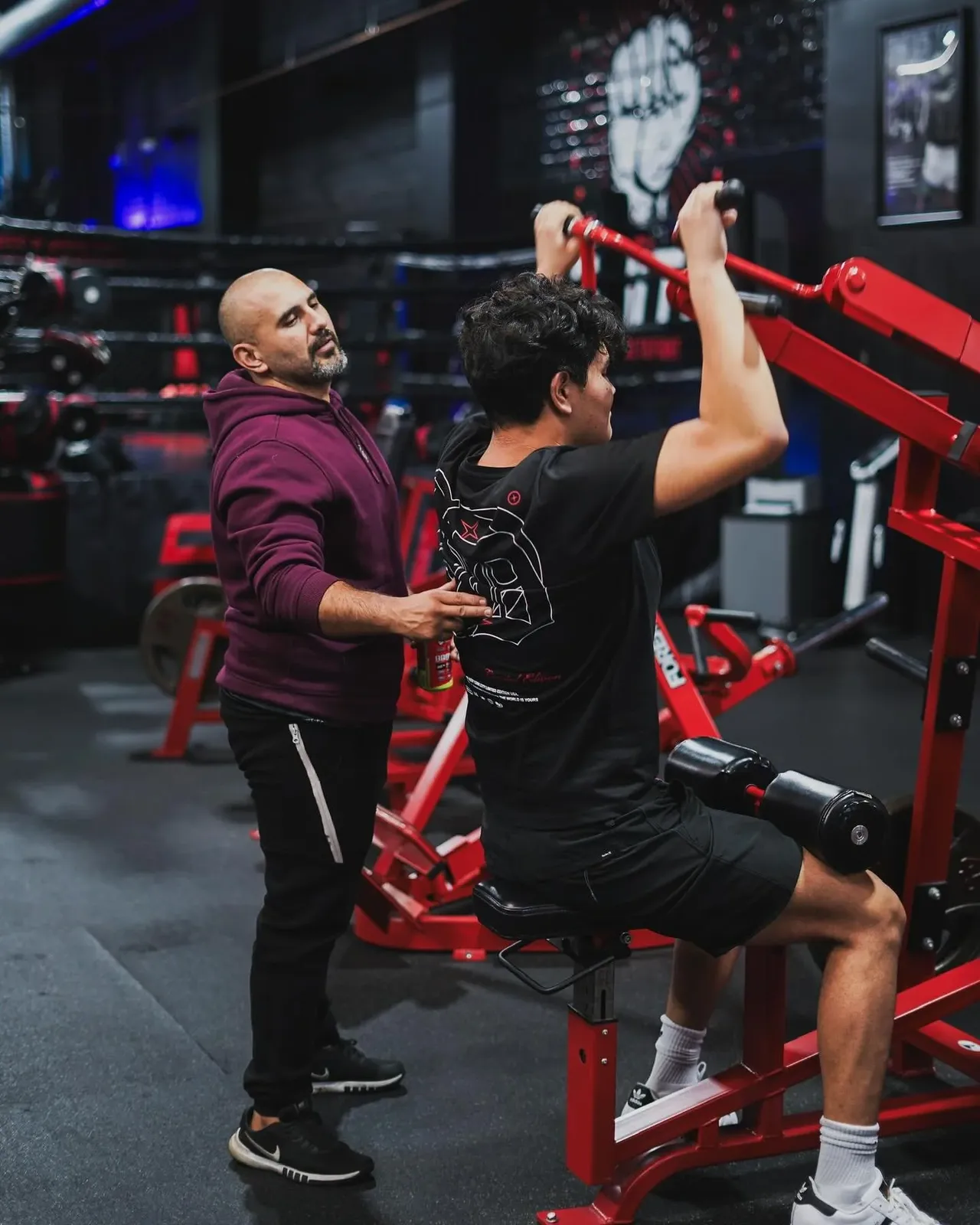
Progressive Overload in Long Beach: A Trainer's Guide to Building Strength Safely
A Long Beach trainer breaks down progressive overload: real numbers, a 12-week example, and the mistakes that stall strength gains. Train smarter, not just harder.
Progressive overload means gradually increasing the demand placed on your muscles over time — through more weight, more reps, more sets, slower tempo, less rest, or better range of motion — so your body has a reason to adapt. Done safely, it looks like 2.5-5% load increases every 1-2 weeks, not maxing out every session. Skipping the gradual part is why most lifters get hurt or plateau.
A client walked into Trinity last spring bench pressing the same 135 pounds he'd been pressing for eleven months. Same bar, same plates, same sticking point two inches off his chest. He wasn't lazy — he trained four days a week, showed up early, never skipped a session. His problem was simpler and more common than most people think: he had no plan for making the weight harder over time. He was just repeating a workout, not progressing one. That's the difference between training and progressive overload, and it's the single biggest reason people plateau in a Long Beach gym, a home garage, or anywhere else.
Why Your Lifts Stop Moving
Muscle and connective tissue adapt to whatever stress you consistently ask of them. Lift 135 pounds for bench press week after week with no added reps, sets, or load, and your body has zero reason to get stronger — it already handles that stress fine. This isn't a motivation problem. It's a programming problem, and it's the number one issue we correct with new clients in their first month at Trinity.
We see this constantly with people coming from chain gyms. They followed a printed workout card for a year, hit the same weights on the same machines, and wondered why their body composition never changed. The card told them what to do, not how to make it harder. Nobody built in a mechanism for demand to increase.
The fix isn't complicated, but it does require tracking. Our client above added five pounds to his bench every other week for six weeks once we put a real progression scheme in place. By week six he was pressing 150 for the same reps that used to max him out at 135. Nothing else changed — same four days a week, same effort. The only variable was a structured plan for overload.
If you've hit a wall on a lift for more than three or four weeks straight, the problem is almost never your genetics or your age. It's that the workout has stopped asking anything new of your body.
What Progressive Overload Actually Means
Progressive overload is the gradual, planned increase in training demand over time so your muscles, tendons, and nervous system are consistently pushed slightly past what they've already adapted to. It's the mechanism behind every strength or muscle gain you've ever made, whether you tracked it deliberately or stumbled into it by accident.
The key word is gradual. Overload without progression — maxing out every session, jumping weights by 20 pounds because you feel strong — isn't training, it's gambling with your joints. According to the American College of Sports Medicine, novice lifters can typically add load safely at a faster rate than trained lifters, but the model still calls for planned, incremental increases rather than random jumps (source: ACSM Progression Models in Resistance Training).
Here's the baseline math we use with new Trinity clients: once you can complete every prescribed set and rep with good form and roughly two reps left in the tank, you're cleared to add 2.5-5% to that lift. For a 200-pound squat, that's 5-10 pounds. For a 30-pound dumbbell row, that's closer to 2.5 pounds per hand, which is why smaller upper-body lifts often progress in rep count instead of load — plates don't come in half-pound increments.
This is also why a coached environment matters more than most people expect. Left alone, most lifters either progress too slowly out of fear or too fast out of impatience. Both stall results — one through lack of stimulus, the other through injury that forces a stoppage.
Six Ways to Apply Progressive Overload Beyond Adding Weight
Most people think progressive overload only means loading more plates on the bar. That's one lever out of at least six, and relying on load alone is exactly why so many lifters stall or get hurt. At Trinity we cycle through these depending on the client's joint health, experience level, and goal.
We rotate these for clients recovering from injury especially. A post-rehab shoulder often can't handle more load yet, but it can handle a slower tempo or an extra set at the same weight. That's still progressive overload — it's just not the version most people picture.
Rotating methods also protects joints long-term. A 45-year-old client benching three times a week for years needs volume and tempo changes far more than he needs to keep chasing a heavier one-rep max.
A 12-Week Progression Example From Our Floor
Numbers make this concrete. Here's a simplified version of a real 12-week squat progression we ran for a 34-year-old client training for general strength, starting at a 165-pound squat for 3 sets of 8.
That's roughly a 30-pound gain across twelve weeks, or about 2.5 pounds per week on average — but notice it wasn't linear. There was a deload built in at week seven, and load only increased after two full weeks of clean reps at the previous weight. That pacing is what kept this client injury-free while still making measurable progress every month.
The Mistakes That Stall Strength Gains
After years of coaching in Long Beach, the same five mistakes account for most stalled progress we see walk through the door.
Adding weight every single session. This works for maybe the first six weeks of untrained lifting, then it breaks down fast. Strength should progress weekly or biweekly, not daily.
No log book. If you can't tell me what you squatted three weeks ago, you can't plan progressive overload — you're guessing. We require every client to log weight, reps, and how many reps they had left in reserve.
Chasing soreness instead of adaptation. Soreness is not a scorecard. A client who's destroyed for four days after every leg session isn't progressing faster — they're often recovering slower and skipping the next planned session entirely.
Ignoring range of motion for ego load. Half squats with 225 pounds build less strength than full-depth squats with 185. Shortened range inflates the number on the bar without matching the muscle demand.
Never deloading. Lifters who push load every week for months straight almost always hit a wall around week 8-10 — either a plateau or a minor injury that forces an unplanned break. A planned deload prevents both.
Fixing these five issues alone resolves the majority of plateaus we see, often before we change a single exercise in someone's program.
Tracking Your Lifts: The Log Book Rule
We tell every new client the same thing in their first week: if it's not written down, it didn't happen for programming purposes. A phone note, a spreadsheet, or a paper log — the format doesn't matter. What matters is that you can look back and answer three questions for any lift: what weight, how many reps, and how many reps you had left in the tank (your RPE, or rate of perceived exertion).
That third number is the one people skip, and it's the most useful for deciding when to add load. A set of 8 reps at RPE 9 (one rep left) means you're close to your ceiling. The same set at RPE 6 (four reps left) means you're leaving strength on the table and can add weight next session.
Here's a simple log format we use with clients:
Six weeks of this data turns training from guesswork into a decision tree. You stop asking "do I feel like adding weight today" and start asking "did I hit my reps at RPE 7 or better last time — yes, add 5 pounds." That single habit change is often worth more than any exercise swap we could make in a program.
Progressive Overload for Fat Loss, Not Just Strength
A lot of people assume progressive overload is only relevant if the goal is a bigger squat number. That's backwards for anyone in a fat loss phase — it might matter more there. When you're eating in a calorie deficit, your body is looking for tissue to break down for energy, and it will happily take muscle if you give it a reason to.
Progressive overload is the signal that tells your body to protect that muscle. A client cutting from 210 to 185 pounds over four months who keeps adding reps or load to her main lifts holds onto far more lean mass than one who just does the same circuit class three times a week. The research on resistance training and muscle protein synthesis backs this up directly — mechanical tension from training is what drives the body to preserve and build tissue, deficit or not (source: NIH — Resistance Training and Muscle Protein Synthesis).
Practically, this changes how we program fat loss clients. We don't chase heavier and heavier weight during a deep deficit — energy for max-effort lifts just isn't there. Instead we hold load steady and progress through volume or density: same 95-pound deadlift for 3 sets of 10 instead of 3 sets of 8, or the same weights with rest cut from 90 seconds to 60. The scale moves down. The lifts don't move backward. That combination is what makes someone look leaner and harder, not just smaller.
Deloads: When Backing Off Is the Progressive Move
Every client who's been with us longer than three months has heard me say this: a deload week is not a break from progress, it's part of it. We build a lighter week — roughly 50-60% of normal working weight, same movement patterns, fewer sets — into every training block about every 4-6 weeks.
The reason is mechanical, not psychological. Tendons and connective tissue adapt more slowly than muscle does. You can get strong enough in a muscle to lift more weight before your elbow tendon or lower back has caught up, and that gap is where overuse injuries happen. A deload lets tissue catch up to strength gains instead of falling further behind.
Signs a client needs one, even off the normal 4-6 week schedule: two straight sessions with a stalled or dropping number, a joint ache lasting more than 48 hours, or sleep quality tanking despite normal training volume. When we see two of these together, we cut load immediately rather than waiting for the calendar to line up.
Clients resist this at first — nobody wants to feel like they're going backward. But the pattern is consistent: the block immediately after a deload almost always produces a personal record within the first two weeks. Backing off on purpose is what makes the next push forward possible.
Nutrition and Recovery: The Other Half of the Equation
You cannot progressively overload a body that isn't fed or rested enough to adapt. This is the piece that gets ignored most, because it happens outside the gym where nobody's watching.
Protein is the clearest lever. Clients trying to add strength while eating under 0.7 grams of protein per pound of bodyweight almost always stall regardless of how well the training is programmed. We generally target 0.7-1 gram per pound for clients in a strength or muscle-focused phase — for a 170-pound person, that's roughly 120-170 grams a day, spread across three or four meals rather than crammed into one.
Sleep matters just as much and gets ignored more. Under 6 hours a night consistently blunts strength gains and slows recovery between sessions, which is part of why a client hitting the gym hard on 5 hours of sleep often plateaus despite a well-built program. We ask clients to treat 7-8 hours as a non-negotiable part of their training plan, not an afterthought.
Total calories matter too. A client trying to add 20 pounds to their deadlift while also cutting calories aggressively is fighting two goals with one body's energy supply. It's not impossible, but progress is slower and the training plan needs to account for it — usually with more conservative load increases and a heavier lean on volume methods instead.
Building Your Own Progression Plan
If you're training on your own, start with one lift you already do consistently — squat, bench, deadlift, or a row variation. Log the weight, reps, and RPE for the next two sessions. If you hit all your reps with two or more left in reserve both times, add 2.5-5% next session. If you're grinding out reps at RPE 9 or 10, hold the weight and add a set instead.
Set a deload on your calendar four to six weeks out before you start, not after you feel beat up. Track sleep and protein intake alongside your lifts for at least two weeks — most people are surprised how directly a bad sleep week shows up as a bad lifting week once they're looking at both side by side.
This is exactly the kind of programming we build for every client who walks into Trinity Training Facility, whether the goal is a stronger deadlift, a leaner physique, or getting back to full strength after an injury. If you want a coach tracking these numbers with you instead of guessing week to week, book a consultation with our Long Beach team and we'll build your first 12-week progression together.
Key Takeaways
- Progressive overload is any method that increases training demand over time — weight is only one of six levers you can pull.
- A safe strength progression adds roughly 2.5-5% load every one to two weeks once a lift feels solid at the current weight for 2-3 sessions.
- Most stalled clients we see at Trinity aren't undertrained — they're under-recovered, under-fed, or not tracking numbers at all.
- A planned deload every 4-6 weeks is what allows the next block of overload to actually work.
- Logging every set, rep, and RPE score is the single highest-leverage habit for long-term strength gain.
- Fat loss clients still need progressive overload — it's what protects muscle while the scale moves down.