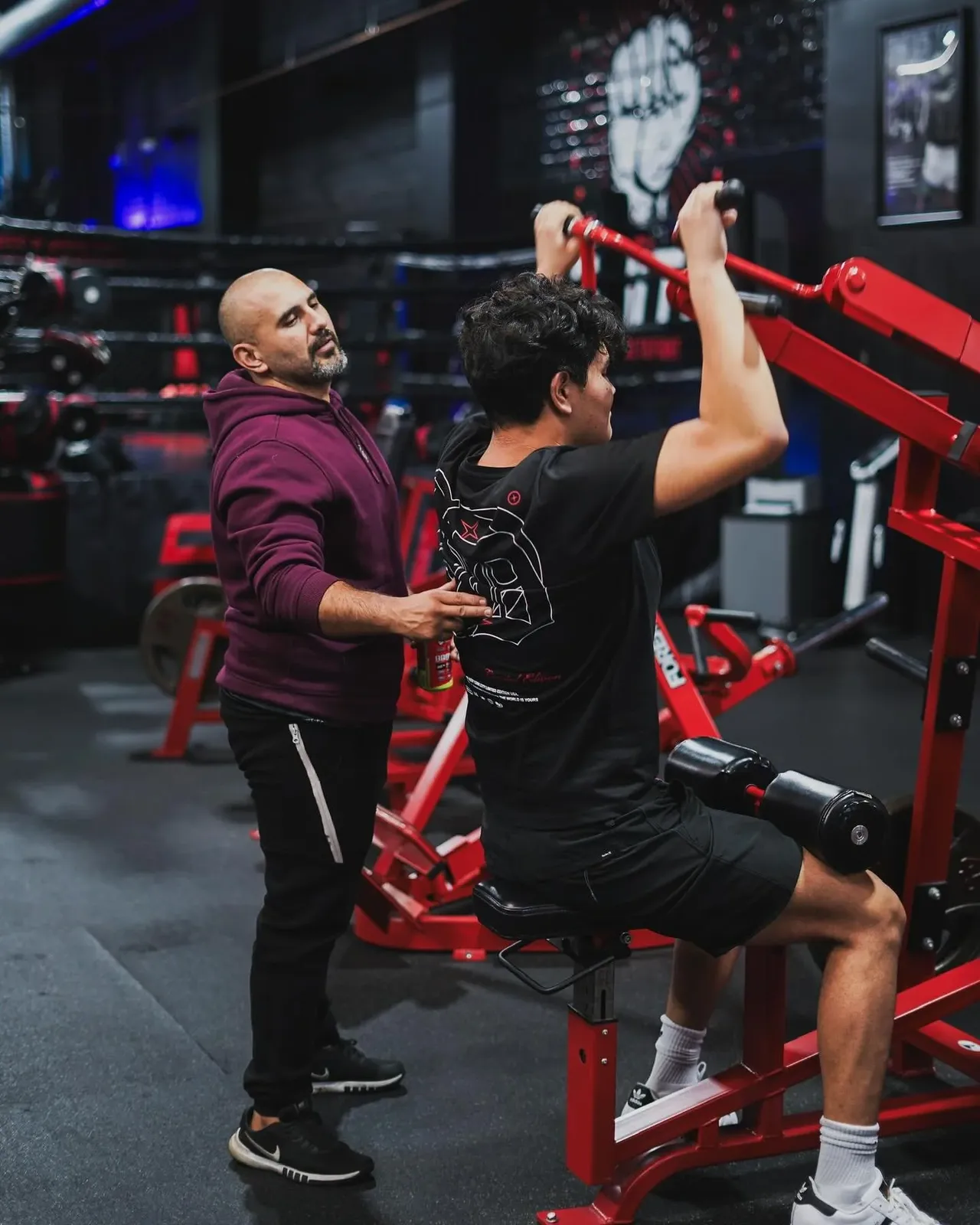
Unlocking Progressive Overload for Long Beach Strength Training: A 4-Week Plan to Maximize Muscle Growth
A 4-week progressive overload plan built by a Long Beach training facility. Real numbers, weekly targets, and the mistakes that stall muscle growth.
Progressive overload means systematically increasing the demand placed on your muscles — through load, reps, sets, or bar speed — over a set timeframe rather than randomly adding weight when it feels right. A structured 4-week cycle (baseline week, volume week, intensity week, deload/test week) with tracked numbers produces measurable strength and size gains that year-round guessing in a commercial gym rarely does.
The Client Who Lifted the Same Weight for Eight Months
A guy named Marcus walked into Trinity Training Facility in January benching 185 lbs for 3 sets of 8. He came back in August still doing 185 for 3x8. He hadn't missed a workout, wasn't injured, and trained four days a week at a 24 Hour Fitness near his office. What he didn't have was a plan that forced his body to do anything harder than what it had already adapted to.
That's the pattern we see constantly with new clients coming from chain gyms in Long Beach. They're consistent with attendance but inconsistent with demand. Muscle and strength only grow when the training stimulus keeps exceeding what the body has already handled — a principle called progressive overload. Skip it, and you get Marcus: eight months, zero progress, same 185 lbs.
This article breaks down exactly how we rebuild a lifter's program using a 4-week progressive overload block — the same structure we run with clients training for strength, physique, or general fat loss goals at our Long Beach facility. No vague advice to "lift heavier when you can." Real numbers, real week-by-week targets, and the mistakes that quietly kill progress before a lifter even notices.
What Progressive Overload Actually Means
Progressive overload is the systematic increase of training stress over time — through added weight, added reps, added sets, shorter rest periods, or improved bar speed — so the muscle is never training at the exact same output twice in a row. The American College of Sports Medicine has published resistance training guidelines built entirely around this principle because it's the single most reliable driver of both strength and hypertrophy adaptations.
Most people think progressive overload just means "add 5 lbs when you can." That's one method, but it's the crudest one. A more complete approach tracks volume load — sets multiplied by reps multiplied by weight. If you do 3 sets of 10 at 100 lbs, that's 3,000 lbs of volume load for that lift. Next session, hitting 3 sets of 10 at 105 lbs is 3,150 lbs — an increase even if it feels like a small jump on the bar.
Overload can also come from density: doing the same weight and reps in less total time by trimming rest from 90 seconds to 60 seconds. Or from tempo: slowing the eccentric (lowering) phase from 1 second to 3 seconds, which increases time under tension without touching the loaded plates at all.
The mistake most home-grown lifters make is picking one method — usually just adding weight — and riding it until it breaks down, either through a plateau or an injury. A structured plan rotates through these levers deliberately, which is exactly what the 4-week block below is built to do.
Why Long Beach Lifters Plateau Before They Even Start
We pull intake data from every new client at Trinity, and the pattern is consistent: roughly 70% of people coming from a commercial gym background have no written log of their lifts from more than two weeks prior. They remember approximate numbers ("I think I did 135 for bench last month") but have no actual record to build from.
Without a logged baseline, progressive overload is impossible — you can't systematically exceed a number you don't know. This is the single biggest difference between a $50/month chain gym membership and structured personal training: the tracking infrastructure that makes overload trackable at all.
The second issue is rep range drift. A lifter doing "3 sets of 10-12" for six straight months at the same weight isn't training in a range — they're stuck at one number and calling it a range. True progression means the low end of that range (10 reps) becomes the new floor once you can hit 12 reps with good form, and weight goes up from there.
Third, and most common in Long Beach's beach-adjacent gym culture: lifters chase pump and sweat instead of measurable output. A workout that leaves you exhausted isn't automatically a workout that builds muscle. Fatigue and progressive overload are not the same thing, and confusing them is why plenty of people train hard for years with little to show for it.
The Trinity 4-Week Progressive Overload Framework
We run new strength clients through a repeatable 4-week block rather than an open-ended "just keep adding weight" approach. Each week has a distinct job: establish numbers, build volume, push intensity, then deload and retest. This structure prevents the two failure modes we see most — burnout from constant maximal effort, and stagnation from never pushing hard enough.
Here's the week-by-week breakdown we use with clients training 3-4 days per week on a standard push/pull/legs or upper/lower split:
This isn't arbitrary. Research on resistance training volume, including work published by Schoenfeld and colleagues in the Journal of Strength and Conditioning Research, shows that manipulating volume and intensity in separate blocks produces more consistent hypertrophy than randomly increasing both at once. Random increases usually mean a lifter unconsciously backs off intensity to handle more volume, or vice versa — netting close to zero actual overload.
Week 1: Baseline Testing and Bar Speed
Week 1 isn't about hitting personal records. It's about establishing an honest, written number for every major lift: squat, bench, deadlift, overhead press, row, and 2-3 accessory movements. Clients use a simple RPE (Rate of Perceived Exertion) scale from 1-10, and we ask them to land every working set at a 7 or 8 — meaning 2-3 reps left in the tank, not grinding to failure.
Concretely, this looks like: 4 sets of 6 back squat at a weight where rep 6 is hard but controlled, bar speed still crisp on the way up. If the bar visibly slows on reps 4-5, the weight is too heavy for a baseline week — drop 10% and log that instead.
We also record rest periods (typically 90 seconds for compound lifts, 60 for accessories) because rest is a variable we'll manipulate later. Everything gets written down: exercise, weight, reps, sets, RPE, and rest. A phone note or a $4 notebook works fine — the format doesn't matter, the consistency does.
By the end of Week 1, a client should have 6-10 logged numbers that represent a real, repeatable starting point. This is the number Marcus never had. Once you have it, every future week has something concrete to beat.
Week 2: Adding Volume Load
Week 2 keeps the weight from Week 1 identical but adds one additional working set to each major lift. If Week 1 was 4 sets of 6 at 185 lbs on bench, Week 2 becomes 5 sets of 6 at 185 lbs. Volume load jumps from 4,440 lbs (4x6x185) to 5,550 lbs (5x6x185) — a 25% increase in total work without changing the weight on the bar at all.
This matters because adding volume before adding intensity lets the connective tissue (tendons and ligaments) adapt gradually. Tendons adapt roughly 2-3 times slower than muscle tissue, which is a major reason lifters who jump straight to heavier weights every week end up with tendinitis in the elbow or shoulder within 8-10 weeks.
We also introduce a density change in Week 2: rest periods on accessory lifts drop from 60 seconds to 45 seconds. This raises the metabolic demand of the session without touching the primary lift's loading, giving a second overload lever alongside the added set.
Clients typically report Week 2 as the most fatiguing week of the block — more sets, less rest, same weight. That's expected and correct. The nervous system is adapting to handling more total work, which sets up Week 3's intensity increase to feel more manageable than it otherwise would.
Week 3: Intensity Blocks and RPE
Week 3 drops back to the Week 1 set count but pushes the weight up 5-10%. Using the same bench example: back to 4 sets, but now at 195-200 lbs instead of 185. RPE targets shift from 7-8 in Week 1 to 8-9 in Week 3 — meaning only 1-2 reps left in the tank on the final set.
This is the week where form breakdown shows up first if a client has been rushing progress. We watch specifically for three things: bar path drifting off a straight vertical line on bench, knees caving inward on squat, and lower back rounding on deadlift. Any of these triggers an immediate weight reduction of 10-15%, no exceptions — a heavier number with broken form isn't overload, it's injury risk with extra steps.
For clients training for physique or fat loss goals rather than pure strength, we adjust Week 3 slightly differently: instead of pushing 1-rep-max-adjacent weight, we hold the Week 2 weight and drop rest periods further (45 seconds down to 30 on accessories) while adding a drop set on the final working set of 2 major lifts. This keeps intensity high through metabolic stress rather than pure mechanical load, which fits hypertrophy goals better than max-strength goals.
By the end of Week 3, most clients have handled meaningfully more weight and more total volume than they were doing four weeks earlier — and they have the logged numbers to prove it.
Week 4: Deload, Test, and Reset
Week 4 cuts total volume by 40-50%. If Week 3 had 4 sets of 6 at 195 lbs, Week 4 might be 2 sets of 6 at 155-165 lbs — noticeably lighter, noticeably less total work. This isn't a rest week in the sense of skipping the gym; it's a planned reduction that lets accumulated fatigue in the joints and central nervous system clear out.
Skipping this step is the number-one reason people burn out on progressive overload programs around week 6-8 of continuous pushing. Joint pain creeps in, sleep quality drops from accumulated stress, and motivation tanks right when the program was starting to produce visible results. A deload prevents that crash.
Mid-week, once fatigue has cleared (usually by session 2 of Week 4), we retest. This isn't always a true 1-rep max — for most clients we test a 3-rep max on the primary lift, since true 1RM testing carries more injury risk and isn't necessary to confirm progress. A client who started the block at 185x6 and finishes testing 205 for a clean 3-rep set has objectively gotten stronger in 4 weeks, and that number becomes the new baseline for the next block.
This is also the point where we sit down with clients and review the written log from all four weeks side by side. Seeing 4,440 lbs of volume load in Week 1 next to 6,600+ lbs by Week 3 makes the abstract idea of "progress" into something concrete on paper.
Nutrition and Recovery Rules That Make It Stick
Progressive overload creates the stimulus for growth, but the growth itself happens during recovery — specifically during sleep and through adequate protein intake. We tell every strength client the same baseline target: 0.7-1 gram of protein per pound of bodyweight per day. A 180 lb client is looking at 125-180 grams daily, spread across 3-4 meals so the body has a steady amino acid supply to rebuild muscle tissue between sessions.
Sleep is the second non-negotiable. Clients averaging under 6 hours of sleep consistently show slower strength progression through the 4-week block — usually stalling in Week 3 instead of hitting the planned intensity increase. We ask clients to treat 7-8 hours as part of the training program, not as a separate lifestyle issue.
Total daily calories matter too. A client in a steep calorie deficit for fat loss while also trying to hit aggressive Week 3 intensity targets is working against physiology — you can't fully fuel a heavier lifting session on a 1,000-calorie deficit. For clients prioritizing strength gains during this block, we typically recommend holding at maintenance calories or a modest 200-300 calorie surplus, and saving the aggressive deficit for a separate phase.
Hydration and basic mobility work (10 minutes of hip and shoulder mobility before heavy lower or upper body sessions) round out the recovery side. None of this is complicated, but skipping it undercuts every number gained in the actual lifting program.
Common Mistakes That Kill Progress
The most common mistake is adding weight and reps at the same time, every session, indefinitely. It works for the first 3-4 weeks for beginners, then breaks down because there's no volume or intensity separation left to fall back on when fatigue accumulates. That's exactly the pattern that leads to Marcus-style plateaus — a lifter who was "trying hard" every session with no structured lever left to pull.
The second mistake is treating every session as a personal record attempt. Chasing a new max every workout is not the same as progressive overload — it's a fast track to overtraining and a much higher injury rate, particularly in the shoulder and lower back. Our RPE-based structure exists specifically to prevent this: most sessions should feel challenging but controlled, not maximal.
Third: ignoring the deload. We've had clients skip Week 4 because they "feel fine" and want to keep pushing. Within 2-3 weeks, most of them report nagging joint pain or a sudden, unexplained drop in performance — the classic signature of unmanaged fatigue catching up all at once.
Finally, training without a log. If you can't tell us what you lifted for your last three sessions on a given exercise, you're not practicing progressive overload — you're just working out. The fix is simple and costs nothing: write the number down every single session.
If you're in Long Beach and have been stuck at the same weights for months despite consistent gym attendance, come run a baseline assessment with us at Trinity Training Facility. We'll build your first 4-week block, log your real numbers, and show you exactly where the next 5-10 lbs is going to come from.
Key Takeaways
- Progressive overload requires a tracked baseline in week one — without logged numbers, you're guessing at progress, not measuring it.
- Volume load (sets x reps x weight) is a more reliable growth driver than chasing 1-rep max increases every session.
- A 5-10% weekly increase in working load is sustainable for most lifters; anything higher raises injury risk without added benefit.
- Deload weeks aren't optional — a planned 40-50% volume drop every 4th week prevents the joint pain that ends most home-grown lifting programs.
- RPE (Rate of Perceived Exertion) tracking between 7 and 9 keeps intensity high without grinding through failed reps that stall recovery.
- Long Beach lifters training in commercial gyms plateau most often from lack of a written plan, not lack of effort.