








Hypertrophy Training Guide for Long Beach Lifters
Build muscle faster with a hypertrophy training plan built for Long Beach lifters. Real rep ranges, splits, and recovery numbers that actually work.
Hypertrophy training builds muscle through three drivers: mechanical tension, metabolic stress, and progressive overload. For most Long Beach lifters, that means 10-20 hard sets per muscle group weekly, reps in the 6-15 range, 60-90 seconds rest, and a structured push/pull/legs or upper/lower split trained 4-5 days per week, paired with 0.8-1g of protein per pound of bodyweight and 7-plus hours of sleep.
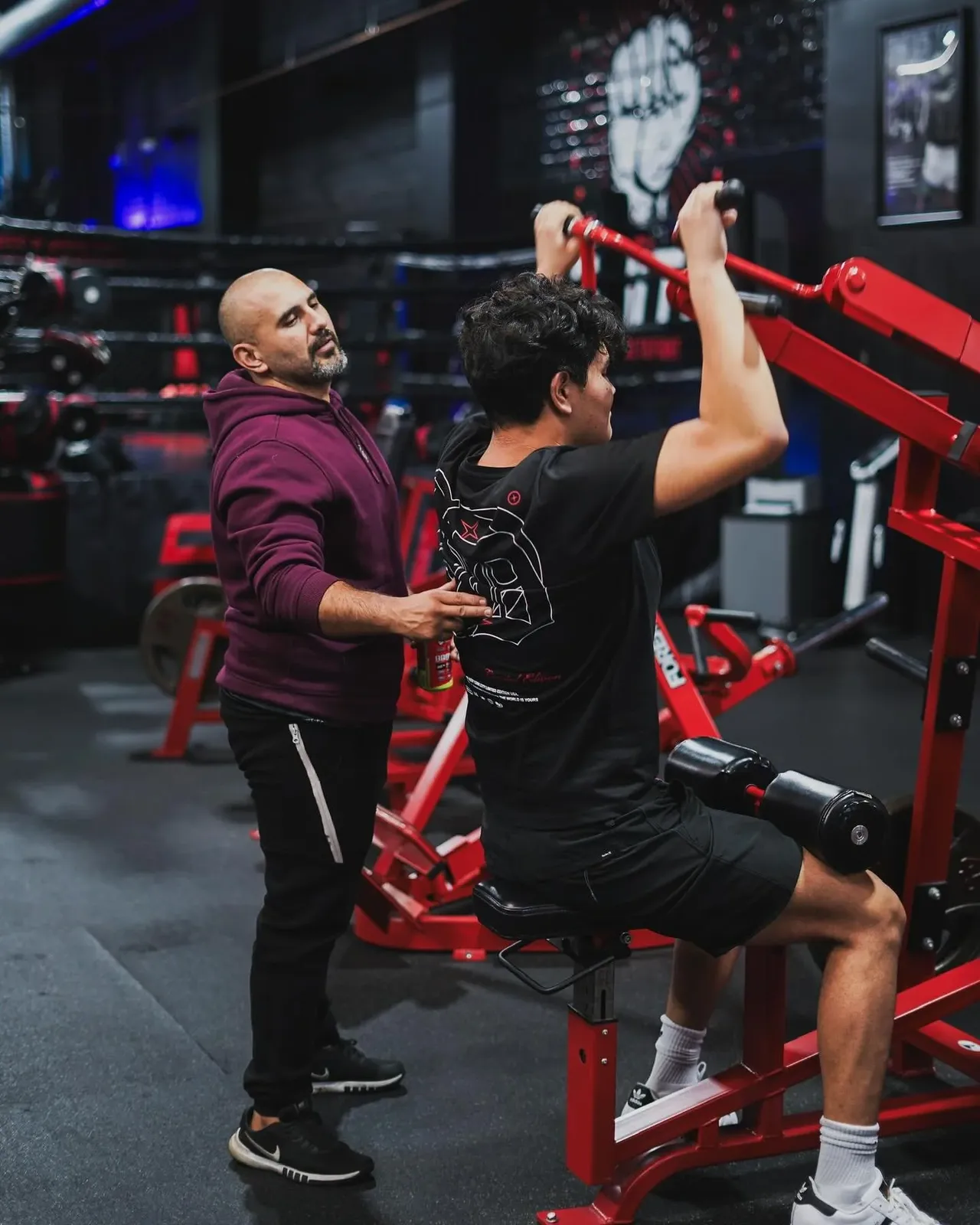
A guy named Marcus walked into Trinity Training Facility last spring after two years of the same routine at a 24 Hour Fitness near the traffic circle. Bench, curls, some treadmill, repeat. He hadn't gained a visible pound of muscle in eighteen months despite showing up four days a week. His problem wasn't effort. It was that nothing about his training ever changed, and his body had no reason to build new tissue it didn't need. That story plays out constantly in Long Beach gyms, and it's exactly why a real hypertrophy plan — one built on specific numbers, not vibes — matters more than showing up.
Hypertrophy training is the science of forcing muscle tissue to grow bigger, and it responds to very specific inputs: mechanical tension, metabolic stress, enough volume, and progressive overload over weeks and months. Get those four right and muscle growth becomes almost inevitable. Get them wrong, like Marcus did, and you can train hard for years and look the same in the mirror. This guide breaks down exactly how to structure your training, your rep ranges, your recovery, and your nutrition to build real, visible muscle.
Why Most Long Beach Lifters Plateau on Size
The most common reason people stop growing isn't lack of effort — it's lack of a plan. I see three patterns repeatedly at the facility: random exercise selection with no weekly structure, the same weight on the bar for months, and workouts that end the second discomfort shows up rather than pushing close to failure.
Marcus was doing 12 sets of chest per week, which sounds reasonable, but he was doing the same 3 exercises, same weight, same 10 reps, every single Monday for two years. His body adapted once, in month one, and then had zero reason to change again. Muscle grows in response to a demand it hasn't met before, not in response to repetition of a demand it has already conquered.
The fix is almost always structural rather than about trying harder. Marcus needed a written program with load targets that increased weekly, not more sweat. Within his first eight weeks on a structured plan, he added 15 pounds to his bench and noticeably more shoulder and chest thickness — not because he suddenly became more motivated, but because the program now demanded progress instead of allowing sameness.
The Three Drivers of Muscle Growth
Mechanical tension is the load your muscles handle against resistance — heavier weight and harder contractions create more of it. This is the primary driver of hypertrophy, which is why lifting genuinely challenging weight matters more than "feeling the burn."
Metabolic stress is the pump and burn from higher-rep, shorter-rest work that floods muscle tissue with metabolites. It contributes to growth but is a secondary driver — useful for finishing a muscle group, not for building your whole program around.
Muscle damage from novel or eccentric-focused movement plays a smaller, more debated role, but it's why changing exercises periodically (not every session, but every 6-8 weeks) helps continued growth.
Programs that ignore mechanical tension and only chase the pump — common in group fitness classes — plateau fast. Programs built primarily around heavy compound work, with metabolic finishers layered in, keep producing results for years.
Structuring Your Weekly Split for Growth
Volume distribution matters more than which split you choose, but for most lifters training 4-5 days a week, an upper/lower or push/pull/legs split hits each muscle group twice weekly, which research consistently shows outperforms training a muscle once per week for hypertrophy.
A sample 5-day push/pull/legs/upper/lower week looks like this: Monday push (chest, shoulders, triceps), Tuesday pull (back, biceps), Wednesday legs, Thursday upper, Friday lower, weekend off. Each muscle group gets trained twice, with total weekly sets landing in the 12-18 range per muscle for intermediate lifters.
Beginners do better with 3 full-body sessions per week — Monday, Wednesday, Friday — hitting every major muscle group each time at 3-4 sets per exercise. This works because beginners recover faster and need less per-session volume to trigger adaptation.
If you're building a longer-term periodized plan around these splits, our guide on developing a periodized strength training plan walks through how to sequence volume and intensity across multiple training blocks rather than winging it week to week.
Rep Ranges, Load, and Rest Periods
The old rule that "6-12 reps builds muscle, anything else doesn't" is outdated. A 2016 meta-analysis by Schoenfeld and colleagues found comparable hypertrophy across low-rep (under 6), moderate-rep (6-15), and high-rep (15-plus) training when sets were taken close to failure and total volume was matched.
That said, moderate loads in the 6-15 rep range remain the most practical default because they balance joint stress, session time, and effort tolerance. A typical set structure: compound lifts at 6-10 reps with 2-3 minutes rest, accessory and isolation work at 10-15 reps with 60-90 seconds rest.
Rest period matters because it governs how much load you can handle on your next set. Cutting rest to 30 seconds to "keep the heart rate up" sounds efficient but forces you to drop weight, which reduces mechanical tension — the primary growth driver. Save short rest for finishing supersets, not your main lifts.
Effort matters as much as reps or rest. Training within 1-3 reps of failure (leaving 1-3 "reps in reserve") produces growth equal to true failure training with far less fatigue, according to strength research from the NSCA. Save all-out failure sets for your last set of an isolation exercise.
Progressive Overload Is Non-Negotiable
Marcus's real problem, stated plainly, was that he never applied progressive overload — the gradual increase of weight, reps, or sets over time that forces adaptation. Without it, your body has no biological reason to add muscle tissue; it already handles the current demand just fine.
Practically, this means tracking every session. If you benched 135 pounds for 3 sets of 8 last week, this week you aim for 135 for 3 sets of 9, or 140 for 3 sets of 8. Small, consistent jumps of 2.5-5 pounds on upper body lifts and 5-10 pounds on lower body lifts, applied weekly or biweekly, compound into major strength and size gains over a training year.
Our full breakdown in Unlocking Progressive Overload: A Step-by-Step Guide to Building Strength covers the exact methods — double progression, load progression, and density progression — that keep this moving without forcing failure every session.
When a lift stalls for 2-3 straight sessions, that's a signal to change rep range, deload 10% for a week, or swap the exercise variation, not to abandon the principle. Overload without a plan for plateaus just leads to injury.
Exercise Selection: Compounds First, Isolation Second
Every session should be built around one or two compound lifts — squats, deadlifts, bench press, rows, overhead press, pull-ups — because they move the most weight and recruit the most muscle mass, maximizing mechanical tension per minute in the gym.
Isolation work — curls, lateral raises, leg extensions, tricep pushdowns — fills in muscles that compounds under-train or lets you push a specific weak point closer to failure without the technical breakdown risk of doing so on a heavy compound lift.
A common mistake I see from lifters coming from chain gyms is building an entire session around isolation machines because they feel safer. That approach caps growth potential because isolation exercises simply can't load a muscle as heavily as a compound movement can.
If imbalances are limiting your compound lift progress — a weak upper back stalling your bench, weak glutes capping your squat — it's worth reading 8 Muscle Imbalances Sabotaging Your Strength Training before adding more isolation volume on top of a compensation pattern.
Recovery and Nutrition Windows That Support Growth
Muscle isn't built in the gym — it's built during recovery, when protein synthesis repairs the micro-damage from training. Skimp on recovery and you can run a perfect program and still not grow.
Protein target: 0.8-1 gram per pound of bodyweight daily. A 160-pound woman training for hypertrophy should eat 130-160 grams of protein daily, spread across 3-4 meals of 30-40 grams each, since the body can only use so much protein for muscle repair in a single sitting.
Sleep is the most under-rated growth tool in Long Beach's fitness scene. Under 6 hours of sleep measurably reduces testosterone and growth hormone output and increases cortisol, both of which blunt muscle repair. Target 7-9 hours nightly, especially during heavier training blocks.
Ignore these and even a well-designed program underperforms. I've watched clients with mediocre programming but excellent sleep and nutrition out-progress clients with perfect programming and 5 hours of sleep.
Common Hypertrophy Mistakes I See at the Facility
The biggest mistake is chasing soreness as a proxy for progress. Soreness reflects novelty, not growth stimulus — a client who's sore every session from constantly changing exercises is often getting less consistent overload than one who feels only mild soreness but adds weight every week.
The second mistake is doing too much volume too fast. Jumping from 8 sets per muscle group weekly to 24 sets because "more must be better" typically produces worse recovery, worse performance in each session, and stalled growth. The research-backed range of 10-20 sets per muscle group weekly is a ceiling most people should approach gradually, not a floor to exceed immediately.
The third mistake is neglecting deload weeks. Every 4-6 weeks of hard training, a week at 50-60% of normal volume lets joints and the nervous system recover, which is what allows the next block to actually produce new growth rather than accumulated fatigue.
The fourth mistake is training the same rep range and exercises indefinitely because they're comfortable. If your triceps have done skull crushers at 15 reps for a year straight, they've likely stopped responding — a swap to close-grip bench at 6-8 reps for a training block often restarts progress within 3-4 weeks.
Tracking Progress the Right Way
The scale is a poor tool for tracking hypertrophy progress because it can't distinguish muscle gain from fat gain or water fluctuation. Better tools: a lifting log tracking weight and reps per set, tape measurements of arms, chest, thighs, and waist monthly, and progress photos in the same lighting and pose every 2-4 weeks.
A client of ours, a 41-year-old teacher training for physique goals, gained only 2 pounds on the scale over 12 weeks but added an inch to her arms and two inches to her shoulders, because she was building muscle while losing a comparable amount of fat. The scale told her nothing useful; the tape measure and photos told the real story.
Strength tracking matters just as much. If your squat, bench, row, and deadlift numbers are climbing steadily over 8-12 weeks, muscle growth is very likely following, since strength gains and hypertrophy are tightly linked in the 6-15 rep range most hypertrophy programs use.
For a deeper look at how to log and interpret these numbers across a full training cycle, see Progressive Overload Techniques for Faster Muscle Growth, which covers exactly what a rising training log should look like month over month.
Building Your First 8-Week Hypertrophy Block
Weeks 1-2 establish baseline: run your chosen split at moderate volume (10-12 sets per muscle group weekly), recording every weight and rep so you have real numbers to build from, not guesses.
Weeks 3-5 increase load and volume: add 1 set per muscle group and aim for small weekly load increases on your main compound lifts — 5 pounds on lower body movements, 2.5-5 pounds on upper body movements.
Weeks 6-7 push toward peak volume for the block, landing around 16-20 sets per muscle group weekly for intermediate lifters, with most sets taken within 1-2 reps of failure.
Week 8 is a deload: cut volume to roughly half and intensity to about 60% of your working weights, letting your joints and nervous system recover before starting the next block heavier than where this one began.
For a fully mapped-out longer version of this structure, our 12-Week Progression Plan for Long Beach Athletes extends this same framework across three full blocks with specific load targets for each week.
If you want this built specifically around your current lifts, schedule an assessment at Trinity Training Facility. We'll test your current numbers, map an 8-week hypertrophy block with exact loads and rep targets, and adjust it in person as you progress — no guessing, no wasted months like Marcus's first two years.
Key Takeaways
- Muscle growth requires 10-20 hard working sets per muscle group per week, not endless volume — more isn't automatically better past that range.
- Reps between 6 and 15 build size equally well as long as sets are taken within 1-3 reps of failure.
- Progressive overload — adding weight, reps, or sets over time — is the single non-negotiable driver of hypertrophy.
- Protein intake of roughly 0.8 to 1 gram per pound of bodyweight, spread across 3-4 meals, supports the muscle repair that training triggers.
- Recovery windows of 48-72 hours between training the same muscle group prevent the interference that stalls growth.
- Tracking load, reps, and sleep in a log is what separates lifters who add muscle every month from lifters who plateau for years.
Sources
- Schoenfeld et al., "Dose-response relationship between weekly resistance training volume and increases in muscle mass" — Journal of Sports Sciences
- International Society of Sports Nutrition Position Stand: Protein and Exercise
- National Strength and Conditioning Association — Resistance Training Volume and Muscle Hypertrophy