








How Progressive Overload Builds Real Strength
Stuck at the same weight for weeks? Learn the 5 progressive overload levers, a real 12-week example, and how to track progress at our Long Beach gym.
Progressive overload means systematically increasing training demand through load, volume, density, range of motion, or frequency so your body is forced to adapt. Pick one lever, change it on a set schedule (roughly 2-10% at a time per ACSM guidance), log every session, and deload every 4-6 weeks. Without a written plan and a tracked number, you're not progressing, you're just repeating a workout.
You added five pounds to the bar every week for two months, then it stopped. Same weight, same reps, same grind for six weeks straight, and the number on the plate hasn't moved since. That's not an age problem or a genetics excuse — it's a programming problem. Progressive overload is the single mechanism that forces your muscles, joints, and energy systems to adapt, and if you're not managing it on purpose, you're leaving strength sitting on the table. Here's how we build it into programs for lifters, boxers, and post-rehab clients training at our Long Beach facility, with real numbers you can use starting this week.
Why Your Strength Numbers Stopped Moving
A client of ours, we'll call him Marcus, came in benching 185 for three sets of eight. Three months later he was still benching 185 for three sets of eight. He hadn't gotten weaker, he'd just stopped giving his body a reason to get stronger. Doing the same weight for the same reps week after week trains your nervous system to be efficient at that exact task — which is the opposite of growth.
Your body adapts to the specific demand you place on it, and only to that demand. If the demand never changes, the adaptation stalls. Muscle fibers, tendons, and your central nervous system are all expensive to build and maintain, so your body won't add more capacity than the job requires. No overload, no signal, no growth.
The American College of Sports Medicine's position stand on resistance training progression recommends increasing training loads by roughly 2-10% once you can complete your target reps with good form, depending on your training age and the lift involved. That's a specific, measurable trigger, not a vibe.
Signs you've plateaued without realizing it:
What Progressive Overload Really Means
Progressive overload isn't "add weight every session." That's a rookie mistake that gets people hurt or stuck. It means systematically increasing the total demand on your body over weeks and months, through one or more specific variables, so your body has no choice but to adapt.
Think of it as a dial, not a switch. You can turn it up through load, volume, density, range of motion, or control. You don't need to crank all five at once — in fact, you shouldn't. Most lifters make the fastest, safest progress moving one lever at a time while holding the others steady.
The mistake we see constantly in Long Beach: someone follows a program from Instagram that calls for adding 10 pounds every session on the squat. That works for maybe three weeks before technique falls apart and knees start aching. Real progression respects your recovery capacity and your technical ceiling, not just your ego.
For context on how this fits into a bigger training cycle, our guide on periodization for strength training breaks down how to sequence overload across months instead of just weeks. Progressive overload is the engine; periodization is the roadmap that keeps the engine from burning out.
The Five Levers You Can Actually Pull
You have exactly five ways to increase demand on a lift. Knowing them by name means you stop guessing and start programming.
A 185-pound bencher can progress for months just rotating these five levers without ever maxing out. We've run this exact approach with the clients in our 4-week strength plate challenge, where most of the early gains came from density and technique, not raw load.
A 12-Week Example: Bench Press From 155 to 205
Here's an actual progression framework we've used with a 155-pound bench presser, built in three four-week blocks.
By week 12, that lifter is benching 205 for a top set of 3-5, up from 155 for sets of 8, without a single session that felt like a grinding, form-breaking max attempt. The jump looks dramatic on paper. It wasn't — it was 12 weeks of 5% changes stacked in the right order.
How to Track Progress Without Guessing
If it's not written down, it didn't happen, and you have no idea whether you're actually overloading or just repeating the same workout and calling it progress. We require every client at our facility to log weight, reps, and a difficulty rating for every working set.
Use Rate of Perceived Exertion (RPE) on a 1-10 scale, where 10 means you couldn't have done another rep. A set of 185x8 at RPE 7 has room to grow next week. The same set at RPE 9.5 needs a different approach — more reps at the same weight, not more weight.
A simple log looks like this:
Review it every four weeks, not every session. Session-to-session, strength numbers bounce around with sleep, stress, and food. Over a four-week window, the trend line tells the truth. If your top-set RPE is creeping up at the same weight and reps, your recovery is falling behind your programming — a sign we'll come back to in the deload section below.
Mistakes That Stall Progress (And What To Do Instead)
We see the same four mistakes on repeat with new clients, chain-gym refugees especially.
Mistake 1: Changing exercises every week. If you swap from barbell bench to dumbbell bench to machine press every session, you never build a baseline to overload against. Pick a main lift and stay with it for 4-8 weeks minimum.
Mistake 2: Chasing soreness instead of load. Soreness is not a progress metric. You can be sore from doing something new and badly, or not sore at all from a highly effective, well-practiced lift. Track the numbers, not the ache.
Mistake 3: Ignoring technical breakdown. Adding weight while your form degrades isn't overload, it's injury risk. If rep 5 of 8 looks different from rep 1, the weight is too heavy for that volume — drop it 10% and rebuild.
Mistake 4: Programming by feel, every session, forever. Without a plan, you default to whatever feels good that day, which is almost always too easy. Our breakdown on common strength training mistakes covers three more versions of this same trap and how we correct for it in programming.
The fix for all four is the same: pick a lever, write down the number, change one variable on a set schedule, and give it four weeks before judging the result.
Progressive Overload Beyond the Big Three Lifts
Overload isn't just for powerlifting numbers. It applies directly to fat loss, boxing, and post-rehab training, just with different variables getting prioritized.
For fat loss clients, we overload density and volume more than load. Going from three rounds of a circuit to five rounds in the same 30-minute block, or cutting rest from 45 to 20 seconds, keeps intensity climbing without adding joint stress that a calorie-deficit body can't recover from well.
For boxing conditioning, overload shows up as round count and work-to-rest ratio. A fighter doing 6 rounds at a 2:1 work-to-rest ratio progresses to 8 rounds, then to a tighter 2.5:1 ratio, before any new combinations get added to the round.
For women training for boxing performance or general strength, the lever sequencing matters even more because many clients are newer to loaded training. We start with range of motion and control before ever chasing load — a full-depth goblet squat at a lighter weight builds more usable strength than a shallow squat at a heavier one.
For post-rehab clients, overload is managed in much smaller increments — think 2-3% load jumps and strict rep ranges — because tissue healing timelines don't bend for training enthusiasm.
When and Why to Deload
Every progression plan needs a planned retreat, or your body will force one on you through injury or burnout. A deload is a deliberate week of reduced volume or load — typically 40-60% of your working weight, for about half your usual volume — built in every 4-6 weeks.
Signs you need one now, not next month: your top-set RPE has been climbing for two straight weeks at the same weight, your sleep quality has dropped, your grip or joints ache in a way that wasn't there a month ago, or your motivation to train has quietly cratered.
A deload is not a day off. You still train, just lighter. A lifter benching 205 for 3-5 reps drops to 125-145 for sets of 5 at an easy RPE 5-6 for one week, then resumes the progression. This is where a lot of people lose their nerve and skip it entirely because it feels like losing ground — it isn't. It's how the next 12-week block gets built on fresh tissue instead of accumulated fatigue.
Clients recovering from injury need this managed even more precisely. Our article on how strength training speeds post-injury recovery covers how we scale load for clients who are rebuilding capacity, not just chasing a number.
Recovery and Nutrition: The Other Half of the Equation
Progressive overload only works if your body has the raw material and the time to actually adapt to the stress you're applying. Skip this part and you'll stall out around week 6 regardless of how smart your programming is.
Protein intake matters more than almost anything else on the nutrition side. The research consensus from the International Society of Sports Nutrition's position stand on protein and exercise puts optimal intake for people in a strength-training program at roughly 1.6-2.2 grams per kilogram of bodyweight per day — for a 170-pound person, that's about 125-170 grams daily, spread across 3-4 meals.
Sleep is the second lever most people ignore completely. Under 6 hours a night for a stretch of weeks measurably blunts strength gains and recovery between sessions, no matter how well the program is written. If you're pushing load, reps, or density on 5 hours of sleep, you're not overloading, you're just accumulating fatigue.
Deliberate recovery work between heavy sessions — mobility drills, short low-intensity circuits, or targeted soft tissue work — keeps you able to actually execute the next progression instead of just surviving it. Our guide on 5-minute morning strength circles for recovery is a low-cost way to build that habit without adding to your training load.
Building This Into a Program, Instead of Guessing
You don't need a perfect program. You need a written one, with a plan for which lever moves next and when, and someone checking whether the numbers are actually trending up over a real time horizon. That's the difference between training and just working out.
If you've been stuck at the same weight for more than a month, stop adding random workouts and start managing one variable at a time. Write down your last four weeks of training. If the number hasn't moved, you already know why.
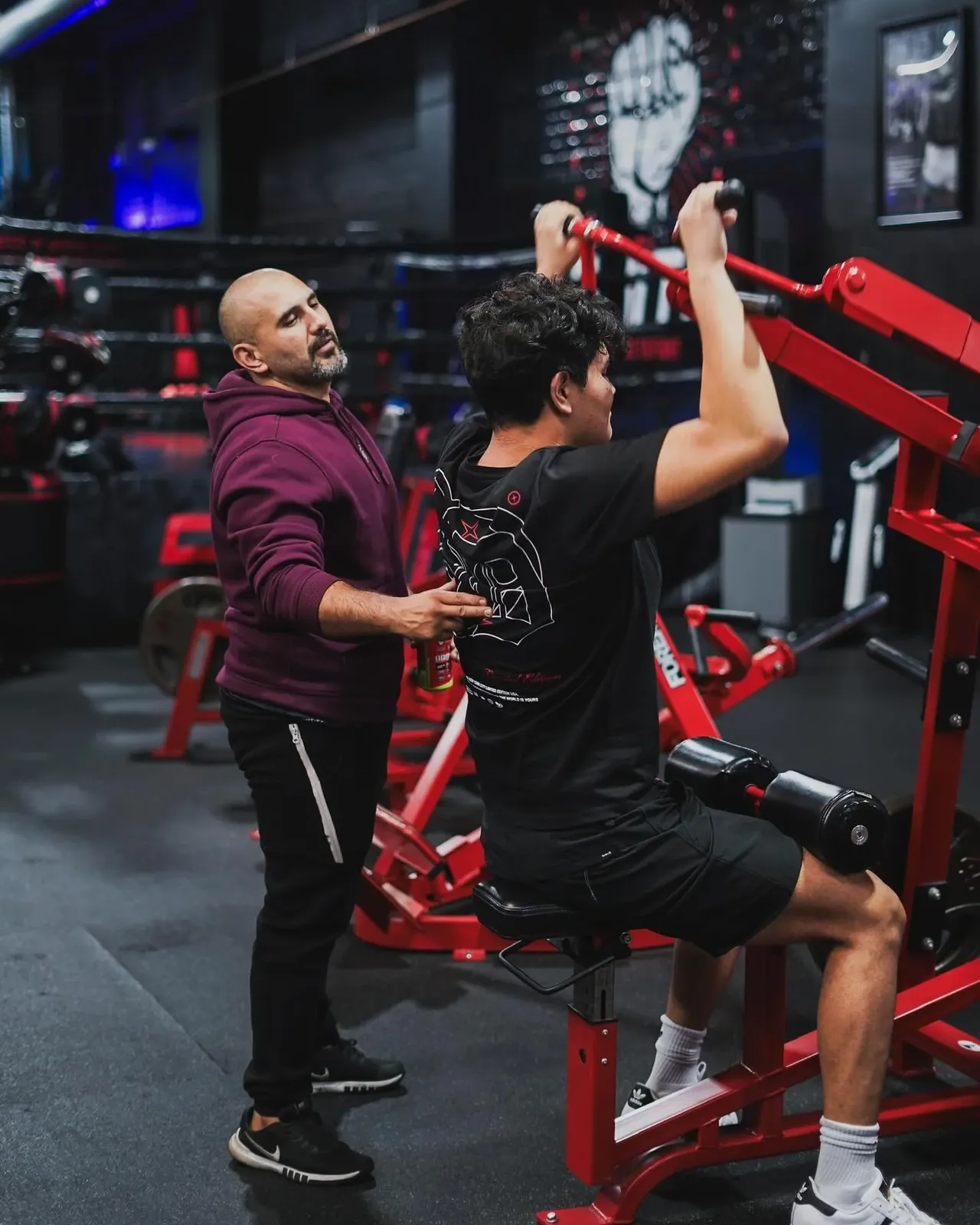
We build every program at our Long Beach facility around exactly this structure — tracked, periodized, and adjusted based on your actual numbers, not a generic template. Book a free intro session or tour and we'll look at your current program, find the plateau, and build the next 12 weeks with you.
Key Takeaways
- Progressive overload works through five levers: load, volume, density, range of motion, and frequency, not just adding weight every session.
- A 2-10% increase per phase, per ACSM's position stand, is enough to force adaptation without breaking technique.
- Logging weight, reps, and RPE every session is the only way to know if you're actually overloading or just repeating a workout.
- Plateaus usually come from changing exercises too often, chasing soreness, or programming by feel instead of by a written plan.
- A deload week every 4-6 weeks at 40-60% of working load prevents the injuries and burnout that force an unplanned break.
- Protein intake of 1.6-2.2 g/kg bodyweight and consistent sleep are what let your body actually adapt to the overload you apply.