








Unlocking Progressive Overload for Strength Gains: A Step-by-Step Guide to Building Muscle Mass in Long Beach
Learn how progressive overload builds real strength and muscle mass, with a step-by-step 12-week framework used at our Long Beach training facility.
Progressive overload means systematically increasing the demand placed on a muscle over time — through more load, more reps, more sets, or better technique — so the body has a reason to adapt. Without a structured way to track and apply it week over week, most lifters plateau within 8-12 weeks. A properly periodized 12-week block that manipulates load, volume, and rest in planned phases produces measurable strength and muscle gains that random workouts never will.
A guy walked into our facility off 2nd Street a few months back and told us he'd been bench pressing 185 for a year. Not 185 as a starting point — 185 as a ceiling he'd been stuck at for twelve straight months, three sets of eight, every single week, no change. He was training consistently. He just wasn't training progressively, and those are two very different things.
This is the single most common issue we see walk through the door at our Long Beach facility: people who train hard but never structure a plan for progressive overload for strength gains. They show up, they sweat, they leave tired — and six months later they're doing the exact same weights they started with. Below is the exact step-by-step framework we use to fix that, including the numbers, the tracking system, and the program structure that actually produces new muscle and new strength.
What Progressive Overload Actually Means
Progressive overload is the systematic increase of stress placed on your muscles, connective tissue, and nervous system over time. The principle is simple in theory: your body only builds more strength and muscle when it's asked to handle more than it currently can. The problem is that most people apply it randomly instead of systematically, which is why "training hard" and "training progressively" produce completely different results.
The research backing this goes back decades, and the American College of Sports Medicine's position stand on resistance training progression lays out the core mechanism clearly: mechanical tension, metabolic stress, and muscle damage are the three primary drivers of hypertrophy, and all three require a training stimulus that exceeds what the tissue has already adapted to.
Here's what that looks like in practice. If you back squat 135 pounds for 3 sets of 10 in week one, and you squat 135 pounds for 3 sets of 10 again in week eight, your quads, glutes, and hamstrings have no reason to get stronger. The load never exceeded what they already handled successfully. Muscle is metabolically expensive tissue for your body to maintain, let alone build — it won't add more without a clear signal that more is needed.
That signal has to be measurable and specific. "I feel like I'm working hard" isn't a training variable. Added weight, added reps, added sets, or a harder tempo are training variables. The rest of this guide breaks down exactly which levers to pull, in what order, and how fast to pull them.
The Six Ways to Apply Progressive Overload
Most lifters think progressive overload means one thing: add weight to the bar. That's the most direct method, but it's one of six, and leaning on it exclusively is why so many people stall out or get hurt trying to force weight increases their joints aren't ready for.
The reason this matters: once you hit a wall on load — say, your bench press hasn't moved in three weeks — you don't need to abandon the lift or assume you've maxed out. Switch the variable. Add a rep. Slow the tempo. Add a second training day for that movement pattern. Each of these creates a new overload stimulus without requiring a heavier bar, which is often exactly what a joint or tendon needs when it's not ready for more external load yet.
A 12-Week Progressive Overload Framework
Random progression variable-switching works better than doing nothing, but a planned 12-week block outperforms both. Here's the structure we run with clients building strength and muscle mass from an intermediate base.
Weeks 1-4 (Accumulation Phase): Focus on adding reps and sets at a moderate, consistent load — typically 70-75% of your working max. Three to four sets of 8-12 reps on primary lifts (squat, bench, deadlift, row), progressing by adding one rep per set each week before increasing weight. This phase builds volume tolerance and technique consistency before loads get heavy.
Weeks 5-8 (Intensification Phase): Shift toward heavier loads and lower reps — 80-85% of working max, 4-6 reps, 4 sets. This is where load progression becomes the primary driver, adding 2.5-5 pounds weekly on main lifts while accessory work stays in the 8-12 rep hypertrophy range to keep total muscle-building volume high.
Weeks 9-11 (Peak Phase): Reduce total volume slightly while pushing intensity to 85-90% of working max on primary lifts, 3-4 reps, 3-4 sets. This phase is where strength gains from the previous eight weeks actually show up as new personal records, since the nervous system has adapted and fatigue from accumulation has been managed down.
Week 12 (Deload): Volume drops by 40-50%, intensity stays moderate around 60-65%. This isn't wasted time — it's what allows the adaptations from the previous eleven weeks to fully consolidate before starting the next block.
Tracking: The Non-Negotiable Piece Most People Skip
The guy stuck at 185 for a year wasn't lacking effort. He was lacking a log. Without a written record of exactly what weight, reps, and sets you did last time, you cannot progressively overload — you can only guess, and guessing tends to default to repeating whatever felt comfortable last week.
A usable training log needs four columns at minimum: exercise, weight, reps completed, and how it felt (using a simple 1-10 effort scale or RPE — rate of perceived exertion). Before every set of an exercise you've done before, you check the log and set an explicit target: "Last time was 185x8 at RPE 8. Today: 185x9 or 190x8."
This sounds basic, but the data backs up why it matters. Studies on resistance training progression consistently show that structured, monitored progression produces greater strength gains over equivalent training periods than unstructured training at similar effort levels. The difference isn't the effort — it's the direction that effort is pointed.
Digital apps work fine, but a physical notebook works just as well and removes the friction of unlocking a phone between sets. What matters is consistency: log every working set, every session, without exception. Two months of consistent logging will show you patterns — which lifts progress easily, which ones stall, which days you're systematically under-recovered — that memory alone will never surface accurately.
Why Progressive Overload Stalls Out
Plateaus rarely happen because someone hit a genuine physiological ceiling. They happen because of a handful of predictable, fixable mistakes.
The most common one: repeating the same weight, reps, and sets indefinitely because it's familiar and safe. Comfort and progress are frequently in conflict — if a set of 185x8 doesn't feel meaningfully harder than it did a month ago, no adaptation signal is being sent.
The second mistake is jumping load too aggressively, adding 10-15 pounds at a time on a compound lift instead of 2.5-5. This usually causes technique breakdown, which either stalls progress through injury or forces regression once form issues show up under heavier load. Small, consistent jumps beat occasional large ones almost every time over a 12-week window.
The third mistake is ignoring recovery capacity while trying to force load progression. Adding weight to the bar every session while sleeping five hours a night and undereating protein is asking the body to build tissue it doesn't have the raw materials or repair window to build. Overload only works if recovery matches the demand.
Recovery: The Half of the Equation People Skip
Progressive overload creates the stimulus for adaptation. Recovery is where the adaptation actually happens — the muscle doesn't get stronger during the set, it gets stronger during the 48-72 hours afterward when protein synthesis rebuilds the tissue with a slightly higher capacity than before.
Protein intake needs to sit around 0.7-1.0 grams per pound of bodyweight daily to support this rebuilding process. For a 180-pound lifter, that's 126-180 grams spread across three to four meals — not a single large serving, since the body uses protein for muscle repair more efficiently when it's distributed throughout the day rather than front- or back-loaded.
Sleep is the other major lever, and it's the one most commonly shortchanged. Growth hormone release, which plays a direct role in tissue repair, peaks during deep sleep. Lifters consistently getting under 6 hours a night show measurably slower strength progression in research on sleep and resistance training outcomes compared to those averaging 7-9 hours, even when training programs are identical.
Between-session recovery also matters at the micro level — 48 hours minimum between training the same muscle group with high intensity, which is part of why a well-structured weekly split (upper/lower, or push/pull/legs) works better for continuous progressive overload than training the same lifts to failure every single day.
When and Why to Deload
A deload week is a planned reduction in training volume and intensity, and it's the piece of progressive overload programming most people skip because it feels like giving up ground. It's the opposite — deloads are what make the next block of progress possible.
Without a deload, accumulated fatigue from weeks of progressive loading eventually outpaces recovery capacity, and performance starts declining even though effort stays high. This typically shows up as an inability to hit the same reps at the same weight that felt manageable two weeks earlier, alongside elevated resting heart rate, disrupted sleep, and reduced motivation to train.
The structure we use: every 4-6 weeks, cut total training volume by 40-50% (fewer sets, same or slightly reduced weight) while keeping movement patterns identical. A lifter doing 4 sets of 5 at 225 on squat drops to 2 sets of 5 at 185-195 for one week, not zero training, just meaningfully reduced demand.
Clients who skip deloads consistently plateau harder and longer than clients who take them on schedule. The math is straightforward: a body that's allowed to fully recover for one week out of every five or six can sustain progressive overload for months. A body pushed continuously without recovery weeks typically breaks down — through injury, burnout, or stalled performance — within 8-10 weeks.
What This Looks Like at Trinity Training Facility
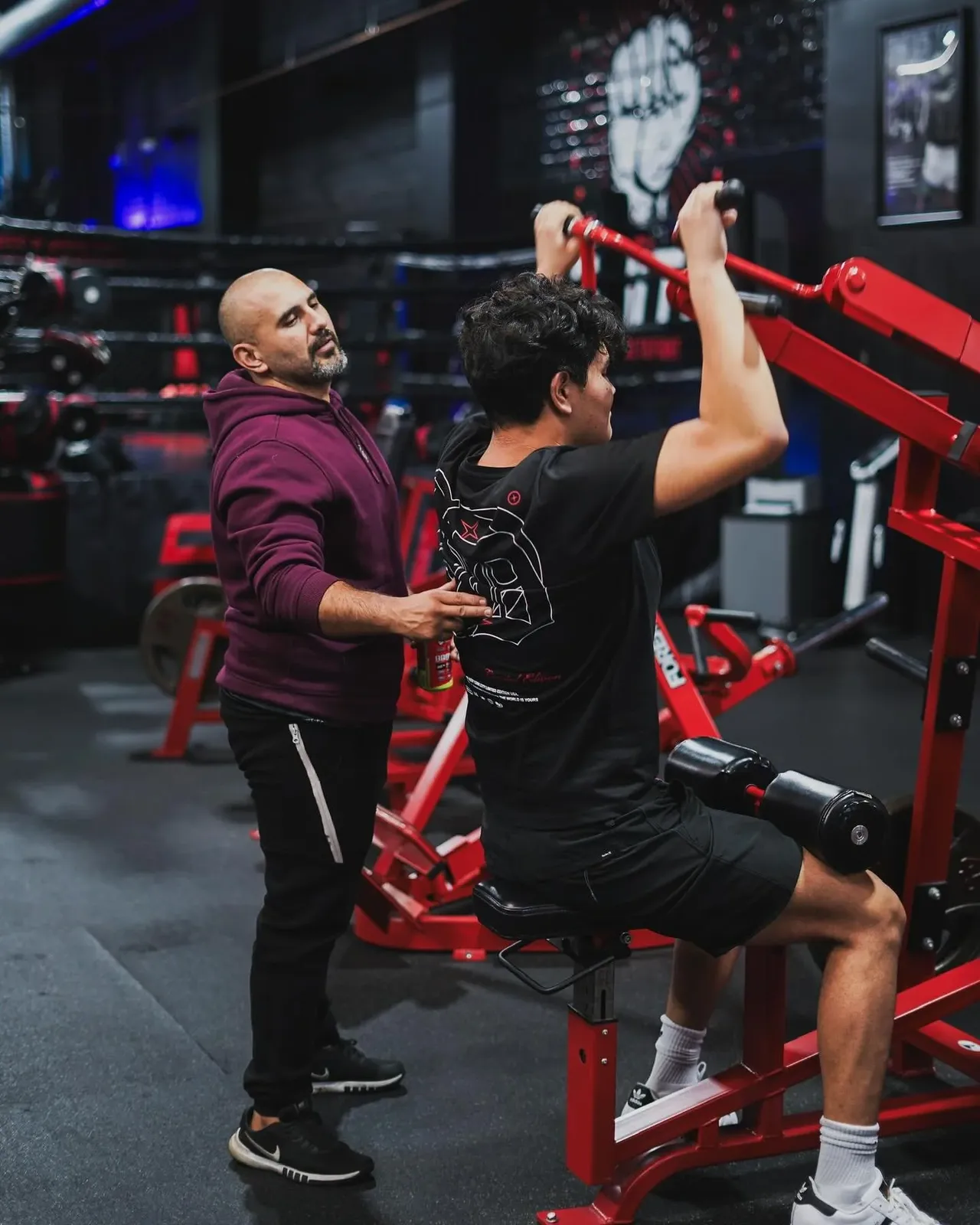
At our Long Beach facility, every new client goes through a movement and strength assessment before any programming begins — squat pattern, hip hinge, pressing mechanics, and baseline working loads on the major compound lifts. This isn't a formality. It's what lets us build the actual 12-week progression around a real starting point instead of a generic template.
Sessions are built around the same phase structure outlined above: an accumulation block to build volume tolerance, an intensification block where the numbers start climbing, a peak phase where new personal records show up, and a deload before the cycle repeats with a new focus. Clients track every session in a shared log we review together weekly, which is how we catch a stalling lift before it turns into three months of no progress.
Equipment-wise, this kind of progressive programming doesn't require anything exotic — a rack, a platform, dumbbells up through heavy pairs, and a place to log numbers. What changes the outcome is the coaching: catching a technique breakdown before it becomes the reason a lift stalls, adjusting the overload variable when load progression hits a wall, and holding the line on a deload week even when a client wants to push through it.
Your Next Step
If you've been training consistently but your numbers on the bar look the same as they did three or six months ago, the fix isn't more effort — it's a structured progression plan and a log to hold yourself to it. Start this week: write down your current working weights, reps, and sets on your three or four main lifts, then commit to adding one measurable variable — a rep, a small load increase, or an extra set — every single session.
If you want that plan built around your actual movement patterns, recovery capacity, and specific sticking points rather than a generic spreadsheet, book a strength assessment at our Long Beach facility. We'll test your current numbers, identify exactly which overload variable will move your numbers fastest, and build the 12-week block around it.
Key Takeaways
- Progressive overload requires a measurable increase in training demand over time — adding weight, reps, sets, or reducing rest — not just showing up and working hard.
- Six variables can be manipulated to create overload: external load, repetitions, sets, time under tension, range of motion, and training frequency.
- Most natural lifters can add 2.5-5 pounds to a compound lift every one to two weeks during a linear progression phase before needing a different overload strategy.
- A written training log is non-negotiable — lifters who track sets, reps, and load see measurably faster strength gains than those who train by feel alone.
- Planned deload weeks every 4-6 weeks, not random rest when fatigue hits, are what allow progressive overload to continue for months instead of stalling out after a few weeks.
Sources
- National Strength and Conditioning Association — Progression Models in Resistance Training
- American College of Sports Medicine — Progression Models in Resistance Training for Healthy Adults
- Schoenfeld, B.J. et al. (2017) — Dose-response relationship between weekly resistance training volume and increases in muscle mass
- National Institutes of Health — Resistance Training and Skeletal Muscle Adaptation